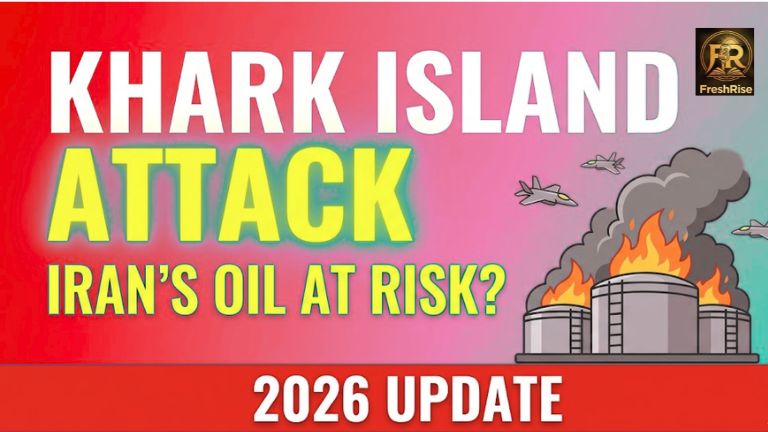
Will the US Seize Iran’s ‘Oil Island’? Kharg Island Strike 2026: What Happens Next?
In a move that has sent shockwaves through global energy markets, U.S. President Donald Trump has announced one of the most powerful aerial operations in Middle Eastern history. The target? Kharg Island, the crown jewel of Iran’s oil economy. This breaking development isn’t just a military skirmish; it is a direct hit to the financial jugular of the Iranian regime. For the average reader, this means potential fluctuations in petrol prices, shifts in international security, and a massive change in how the West deals with Tehran. Today, we break down exactly what happened, why this tiny island matters to your pocket, and the expert consensus on whether a full-scale occupation is next.
What is the 2026 Kharg Island Update?
The situation escalated rapidly when President Trump took to his social media platform, Truth Social, to confirm that the U.S. Central Command (CENTCOM) carried out a precision strike on Kharg Island. According to official statements, the mission successfully neutralized Iranian military assets stationed on the island.
While the “military targets” were destroyed, the U.S. notably spared the actual oil infrastructure—for now. Trump stated that this was a gesture of “dignity,” but issued a stern warning: if Iran interferes with shipping in the Strait of Hormuz, the oil terminals will be next. This marks a significant shift from the “maximum pressure” campaigns of the past to direct kinetic action in 2026.
Who Will Benefit and Who Will Suffer?
The ripple effects of this strike are widespread:
-
Global Oil Markets: Initially, prices spiked as traders feared a total shutdown of Iranian exports.
-
India: As a major oil consumer, India remains on high alert. Any disruption in the Persian Gulf directly affects Indian shipping routes and energy costs.
-
The Iranian Government: With 90% of its oil exports passing through Kharg, the regime faces an existential financial threat.
-
U.S. Strategic Allies: Countries like Israel and certain Gulf nations see this as a necessary step to curb regional instability.
Key Highlights of the Conflict
-
Massive Scale: Described as one of the most powerful bombings in the region’s history.
-
Surgical Precision: Military targets were hit while avoiding the “Oil Piers” to prevent a global energy collapse.
-
Strategic Threat: The U.S. is considering a full “takeover” or “seizure” of the island to control Iran’s cash flow.
-
Hormuz Factor: The Strait of Hormuz remains the ultimate “red line” for both sides.
Why Kharg Island is the “World’s Most Important Rock”
Kharg Island is small—only about 20 square kilometers—but its location in the Persian Gulf makes it irreplaceable.
The 90% Rule
Nearly 90% of Iran’s crude oil exports flow through this single point. If Kharg Island stops functioning, the Iranian economy effectively stops breathing. It is the center point of their maritime oil fields, specifically the Abuzar field, which produces 240,000 barrels of oil daily.
The Infrastructure
The island houses over 40 massive storage tanks capable of holding more than 20 million barrels of crude. It also features a massive petrochemical plant that processes gases into methanol, sulfur, and butane. In short, it is a floating gold mine.
Will the U.S. Actually Seize the Island?
Speculation is mounting that the U.S. might move from “striking” to “occupying.” Reports from Axios and Politico suggest that senior officials are discussing a physical takeover.
Expert Commentary:
“Seizing Kharg Island would be the ultimate checkmate,” says a senior maritime security analyst. “It wouldn’t just be a sanction on paper; it would be physical control over Iran’s primary source of revenue. However, the risk of a wider war remains the biggest deterrent.”
Step-by-Step: How This Affects the Indian Economy
-
Shipping Insurance: As the Persian Gulf becomes a “war zone,” insurance for oil tankers rises.
-
Landed Cost: Higher insurance and freight costs mean India pays more for every barrel of oil, even if it comes from Russia or Iraq.
-
Inflation: If oil stays high, transport costs in India rise, leading to more expensive groceries and fuel.
-
Strategic Reserves: India may need to tap into its strategic petroleum reserves if the Strait of Hormuz is blocked.
Common Obstacles & How to Overcome Them
For businesses and investors tracking this crisis, the main obstacle is misinformation.
-
The Trap: Panic-buying of stocks or commodities based on “rumors” of a total war.
-
The Solution: Monitor official CENTCOM updates and OPEC+ production reports. History shows that while initial strikes cause spikes, markets often stabilize if the oil actually continues to flow.
Important Government Instructions (Advisory)
The Indian Ministry of External Affairs (MEA) usually issues advisories during such escalations.
-
For Seafarers: Avoid unnecessary transit through the North Persian Gulf until clearance is given.
-
For Investors: Exercise caution in energy-sector stocks.
-
For the Public: Do not believe viral WhatsApp videos claiming “petrol will reach ₹500.” The government has reserves to manage short-term shocks.
Practical Advice: Navigating the 2026 Crisis
If you are worried about the impact of the Kharg Island crisis, follow these steps:
-
Diversify: Don’t keep all your investments in transport or oil-dependent industries.
-
Stay Informed: Follow verified news outlets like the BBC or Times of India rather than unverified social media clips.
-
Monitor the Strait: The “Strait of Hormuz” is the real metric. As long as it stays open, the world is safe from a 1970s-style energy crisis.
Conclusion
The 2026 strike on Kharg Island is a turning point in modern geopolitics. By targeting the military assets on Iran’s “Oil Island,” the U.S. has sent a clear message: the era of “strategic patience” is over. While the oil terminals remain standing for now, the threat of a seizure looms large. For the global community, and especially for India, the next few weeks will determine if we face a manageable price hike or a total energy shift.
Frequently Asked Questions (FAQs)
1. Is Kharg Island currently producing oil? Yes, as of now, the oil infrastructure was not destroyed in the U.S. strike. President Trump indicated that the decision to spare the oil piers was intentional to prevent a global economic crash, though this could change if hostilities increase.
2. Why did the U.S. strike Kharg Island now? The strike was reportedly a response to Iranian threats against international shipping in the Strait of Hormuz and their regional military activities. It serves as a “warning shot” to show that their most vital economic hub is vulnerable.
3. Will petrol prices in India go up? Short-term volatility is expected. However, unless the Strait of Hormuz is physically blocked or the Kharg oil terminals are destroyed, the long-term impact may be mitigated by other producers like Saudi Arabia and Russia.
4. Has the U.S. ever seized an island like this before? While the U.S. has conducted “Tanker Wars” in the 1980s to protect shipping, a full-scale seizure of a sovereign nation’s primary oil hub would be an unprecedented escalation in modern history.
5. How many people live on Kharg Island? Approximately 8,000 people reside there. The island is not just an industrial site; it also hosts a university and a local population that has endured thousands of air strikes dating back to the Iran-Iraq war.
Read More:- https://freshrise.in/mysore-gtc-center-jobs-rent-startup-facilities/
link:- https://www.bbc.com/tamil/articles/ckgl5ykzj8go

The Founder of Fresh Rise and a global educator, a digital news platform focused on delivering clear, verified, and meaningful stories that matter to everyday readers. I write about current affairs, government schemes, education, social issues, and global developments, presenting complex topics in a simple and easy-to-understand format.
With a background in teaching and content creation, I believes that information should be accessible to everyone. Through Fresh Rise, i aim to help readers stay informed with factual reporting, practical insights, and timely updates.