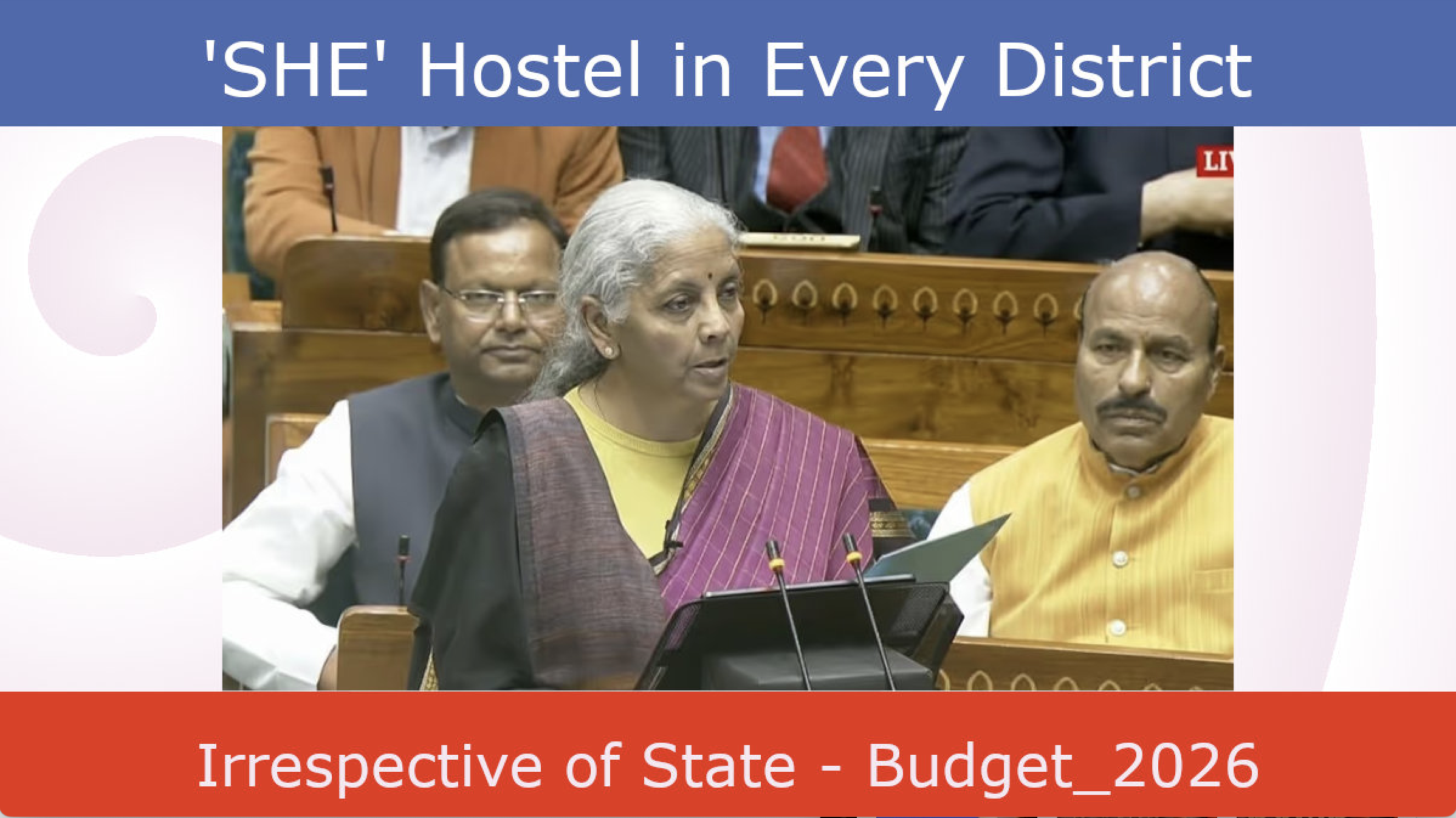
The Union Budget 2026, presented in Parliament on February 1, placed a strong focus on strengthening higher education infrastructure and expanding economic opportunities for women across India. Union Finance Minister Nirmala Sitharaman announced a series of measures aimed at addressing long-standing structural challenges faced by women students and entrepreneurs, including a proposal to construct a girls’ hostel in every district of the country and the launch of community-owned retail platforms known as ‘She MARTS’.
Presenting the Budget, Sitharaman underlined the government’s intent to raise public investment in education and social infrastructure as a foundation for inclusive and sustainable economic growth. She said enhanced funding would support the creation of new educational institutions, university townships, and specialised facilities that can meet the evolving demands of India’s growing student population.
Girls’ Hostel in Every District
One of the most notable announcements in the education sector was the proposal to build a dedicated girls’ hostel in every district. According to the Finance Minister, the initiative is aimed at ensuring safe, affordable, and accessible accommodation for women pursuing higher education, particularly those who migrate from rural and semi-urban areas to attend colleges and universities.
“I propose multiple steps towards setting up new institutes, university townships, girls’ hostel and telescope infrastructure facilities in the investment in the higher education sector,” Sitharaman said while presenting the Budget. She added that the plan to establish a girls’ hostel in every district would help remove a key barrier that often prevents women from continuing their education beyond school.
Education experts and policymakers have long highlighted the lack of safe residential facilities as a major factor contributing to lower enrolment and higher dropout rates among women at the college and postgraduate levels. The government’s proposal seeks to directly address this gap by ensuring that accommodation is not a limiting factor for aspiring women students.
Focus on STEM Education and Research
The Finance Minister also drew attention to the specific challenges faced by women in science, technology, engineering, and mathematics (STEM) disciplines. She noted that many STEM courses require extended hours of classroom instruction, laboratory work, and research, which can become difficult for women students in the absence of secure housing and support infrastructure.
“In higher education, STEM institutions, prolonged hours of study and laboratory work pose some challenges for girl students,” Sitharaman said. The proposed hostels, she explained, would help create an enabling environment for women to fully participate in advanced scientific education and research.
In addition to hostels, the Budget mentioned investments in specialised infrastructure, including telescope facilities, to promote immersive learning and hands-on research in fields such as astrophysics and astronomy. By combining accommodation support with advanced research infrastructure, the government aims to encourage more women to pursue careers in frontier areas of science and technology.
Boost to Women-Led Entrepreneurship Through She MARTS
Beyond education, the Union Budget 2026 placed significant emphasis on women’s entrepreneurship and self-reliance. Sitharaman announced the launch of ‘She MARTS’, short for self-help entrepreneur marts, which are envisioned as community-owned retail outlets operated by women’s collectives.
The initiative builds on the success of the government’s flagship Lakpati Didi programme, which focuses on helping women in self-help groups achieve sustainable income levels. “Building on the success of the Lakpati Didi programme, the government plans to help women move from credit-linked livelihoods to becoming enterprise owners,” the Finance Minister said.
She MARTS will function within cluster-level federations and will receive support through enhanced and innovative financing mechanisms. These marts are expected to provide women entrepreneurs with better market access, branding opportunities, and a stable platform to sell locally produced goods.
According to government officials, the model aims to move women beyond subsistence-level activities and integrate them more firmly into formal value chains. By creating community-owned retail spaces, the initiative also seeks to strengthen grassroots institutions such as self-help groups and federations, making them more resilient and economically viable.
Strengthening Grassroots Institutions
The Finance Minister emphasised that empowering women economically has a multiplier effect on households and communities. By supporting women-owned enterprises through She MARTS, the government hopes to create sustainable income streams, generate local employment, and improve financial inclusion at the grassroots level.
The Budget outlined that branding, logistics, and market linkages would be key focus areas for the initiative. This approach is expected to help women entrepreneurs overcome common challenges such as limited visibility, fragmented markets, and lack of access to professional networks.
Six Broad Priorities for Economic Growth
While education and women’s empowerment were major highlights, Sitharaman also outlined six broad priorities guiding the Union Budget 2026. These include scaling up manufacturing in strategic and frontier sectors, rejuvenating legacy industries, creating champion micro, small, and medium enterprises (MSMEs), delivering a major push for infrastructure development, ensuring long-term security and stability, and developing city-based economic regions.
According to the Finance Minister, these priorities are designed to support India’s long-term economic growth while maintaining macroeconomic stability. She stressed that public investment would play a catalytic role in crowding in private investment across sectors.
Fiscal Responsibility and Budgetary Framework
As required under the Fiscal Responsibility and Budget Management (FRBM) Act, 2003, Sitharaman also laid two key statements before Parliament. These included the Medium-term Fiscal Policy-cum-Fiscal Policy Strategy Statement and the Macro-Economic Framework Statement, which outline the government’s fiscal roadmap and assessment of economic conditions.
These documents provide insights into the government’s medium-term fiscal targets, borrowing plans, and strategies for managing public finances amid global economic uncertainties.
Budget Session Timeline
The Union Budget 2026 was presented against the backdrop of the Economic Survey for the 2025–26 financial year, which Sitharaman had tabled in Parliament earlier in the week. The Budget session is scheduled to run for 30 sittings over a period of 65 days and will conclude on April 2.
Both Houses of Parliament are set to adjourn for a recess on February 13 and reconvene on March 9. During the recess, Standing Committees will examine the Demands for Grants of various ministries and departments, a key step in the parliamentary scrutiny of government spending proposals.
A Step Towards Inclusive Growth
With proposals ranging from district-level girls’ hostels to community-owned retail platforms for women entrepreneurs, the Union Budget 2026 signals a renewed push towards inclusive development. By addressing both educational access and economic participation, the government aims to create pathways for women to contribute more actively to India’s growth story.
As these initiatives move from announcement to implementation, their impact will be closely watched by educators, economists, and civil society groups alike.
The Founder of Fresh Rise and a global educator, a digital news platform focused on delivering clear, verified, and meaningful stories that matter to everyday readers. I write about current affairs, government schemes, education, social issues, and global developments, presenting complex topics in a simple and easy-to-understand format.
With a background in teaching and content creation, I believes that information should be accessible to everyone. Through Fresh Rise, i aim to help readers stay informed with factual reporting, practical insights, and timely updates.