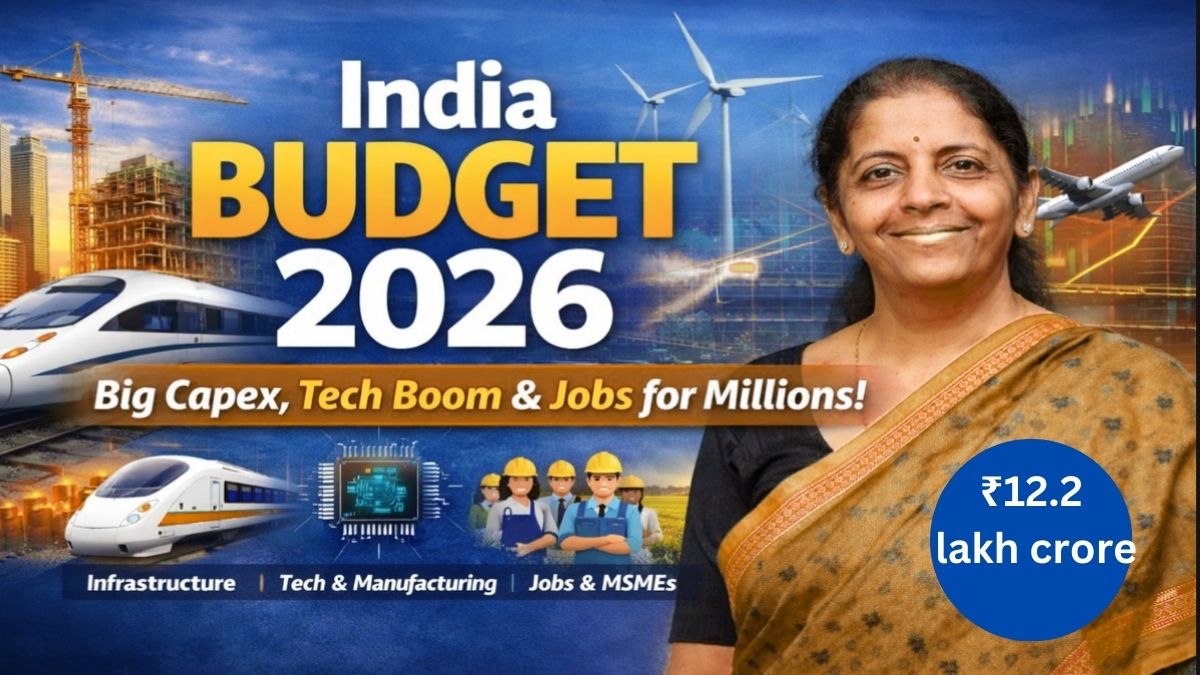
On February 1, 2026, India unveiled its Union Budget for the 2026–27 financial year, a decisive fiscal blueprint aimed at sustaining growth momentum, accelerating industrial transformation, and generating jobs at scale. Presented by Finance Minister Nirmala Sitharaman in Parliament, this budget reflects the government’s strategic push to make India a global manufacturing and innovation powerhouse while strengthening infrastructure, protecting citizens’ wallets, and deepening global competitiveness.
1. A Forward-Looking Capex and Growth Strategy
At the heart of the 2026 budget is a record capital expenditure (capex) of ₹12.2 lakh crore, up from ₹11.2 lakh crore last year — signaling a sustained focus on infrastructure development and economic transformation.
This elevated capex plan supports a host of flagship projects:
- Seven new high-speed rail corridors connecting major cities to boost mobility and economic linkages.
- 20 new national waterways to enhance freight movement and cut logistics costs.
- A new east-west freight corridor linking Dankuni to Surat — critical for the goods movement network.
- Initiatives to promote coastal and inland shipping, targeting a bigger role for waterborne trade routes in India’s logistics landscape.
The capex emphasis aims not just at construction but at unlocking economic corridors of growth, especially in Tier-II and Tier-III cities, enabling balanced regional development.
2. Sectoral Revival: Manufacturing and Strategic Industries
The 2026 budget propels India’s ambitions to become a manufacturing hub for key global industries by offering targeted schemes and large-scale funding:
Tech & Electronics Manufacturing
- The India Semiconductor Mission 2.0 — with a ₹40,000 crore allocation — will develop deep capabilities across semiconductor materials, equipment and full-stack chip design IP.
- Electronics Components Manufacturing outlay also stands at ₹40,000 crore to scale domestic capacity and strengthen supply chains.
Bio-Pharma and Healthcare
- Under the Bio Pharma SHAKTI plan, ₹10,000 crore over five years will boost biotech innovation, advanced research and pharmaceutical production ecosystems in India.
- Customs duty exemptions for key cancer medicines aim to reduce healthcare costs and strengthen access.
Construction and Industrial Machinery
- A dedicated container manufacturing scheme with ₹10,000 crore will help reduce logistics weaknesses and dependency on imports.
- The infrastructure & construction equipment scheme supports indigenous manufacturing of heavy machinery.
Textiles and Traditional Industries
- A comprehensive textile package — including national fibre development, textile parks, and integrated employment schemes — aims to modernise the sector and expand exports.
- Traditional crafts, khadi, handloom and handicrafts sectors will receive a boost under the Mahatma Gandhi Gram Swaraj Mission.
These strategic interventions are designed to strengthen domestic production, create value-chains, reduce imports, and align India with global supply networks.
3. MSMEs, Entrepreneurship and Rural Development
Recognising small and medium enterprises (MSMEs) as growth engines, the Budget provides:
- A ₹10,000 crore SME Growth Fund to support technology adoption, expansion and modernization.
- Additional ₹2,000 crore to the Self-Reliant India Fund to fuel high-potential startups and growth ventures.
- Expanded support for village industries and the One District One Product (ODOP) initiative to boost rural livelihoods.
These measures target increased employment, enhanced rural income generation, and bolstered micro-enterprise ecosystems.
4. Tax Reforms and Financial Sector Changes
The 2026 Budget introduces important reforms aimed at simplifying taxes and deepening financial markets:
- A new Income Tax Act, 2025 will replace the existing six-decade-old statute starting April 1, 2026.
- Corporate tax structures saw key changes, including lowering the MAT rate for certain companies and extending a tax holiday for foreign cloud service providers until 2047 when services are delivered through Indian data centres.
- Financial market development measures include carbon capture funds, reforms in banking governance, and incentives for municipal bonds issuance.
- However, the government also raised the Securities Transaction Tax (STT) on futures trades — a move with immediate impact on the stock market
5. Agriculture, Rural Economy and AI Integration
Agriculture and rural sectors received nuanced attention to promote productivity and modernisation:
- Expansion of AI-driven agriculture technologies through Bharat-VISTAAR initiatives aims to digitise farming practices and increase yields.
- Support programmes for PAC storage capacity and agro-supply chain infrastructure aim to reduce wastage and strengthen market access.
These steps align with India’s broader vision of inclusive agricultural growth and rural livelihood enhancement.
6. Infrastructure & Connectivity — Not Just Roads and Rails
The Budget’s infrastructure push also includes:
- Major freight corridor projects that integrate freight operations across regions.
- Initiatives to expand waterways and coastal shipping, reducing logistics costs and promoting intermodal transport efficiency.
- Dedicated rare earth mineral hubs in Odisha, Kerala, Andhra Pradesh and Tamil Nadu — critical for future technologies like electric vehicles and renewable energy systems.
These investments are intended to strengthen India’s infrastructure backbone and support its climate goals.
7. Tourism, Hospitality & Sports
While infrastructure covers physical networks, the Budget also invests in tourism and cultural sectors:
- A National Institute of Hospitality will be established to bridge education and industry needs.
- Sustainable tourism trails and heritage destinations will be developed to attract global visitors and create jobs.
- The Khelo India Mission will expand sporting infrastructure, talent development pathways and competitive support ecosystems.
These steps aim to leverage India’s cultural assets and youth talent as economic multipliers.
8. Healthcare & Education Strengthening
Health and education sectors also received strategic funding:
- Apart from biotechnology and pharma initiatives, support is planned for upskilling health professionals — including expansion of allied health personnel training.
- Investment in educational infrastructure and digital skills training complements the broader agenda of equipping India’s workforce for future industries.
📌 Final Takeaway
India’s Budget 2026–27 is a multi-dimensional fiscal strategy that goes beyond traditional spending. It combines aggressive capex planning, sectoral reforms, tax restructuring, and social sector investments — all aimed at preparing India for the next decade of growth, innovation, jobs, and global competitiveness.
Expect this Budget to be widely debated and dissected across markets, industries, and citizen groups — but its structural thrust marks a significant turn toward a technology-led, inclusive, and resilient economy.

The Founder of Fresh Rise and a global educator, a digital news platform focused on delivering clear, verified, and meaningful stories that matter to everyday readers. I write about current affairs, government schemes, education, social issues, and global developments, presenting complex topics in a simple and easy-to-understand format.
With a background in teaching and content creation, I believes that information should be accessible to everyone. Through Fresh Rise, i aim to help readers stay informed with factual reporting, practical insights, and timely updates.