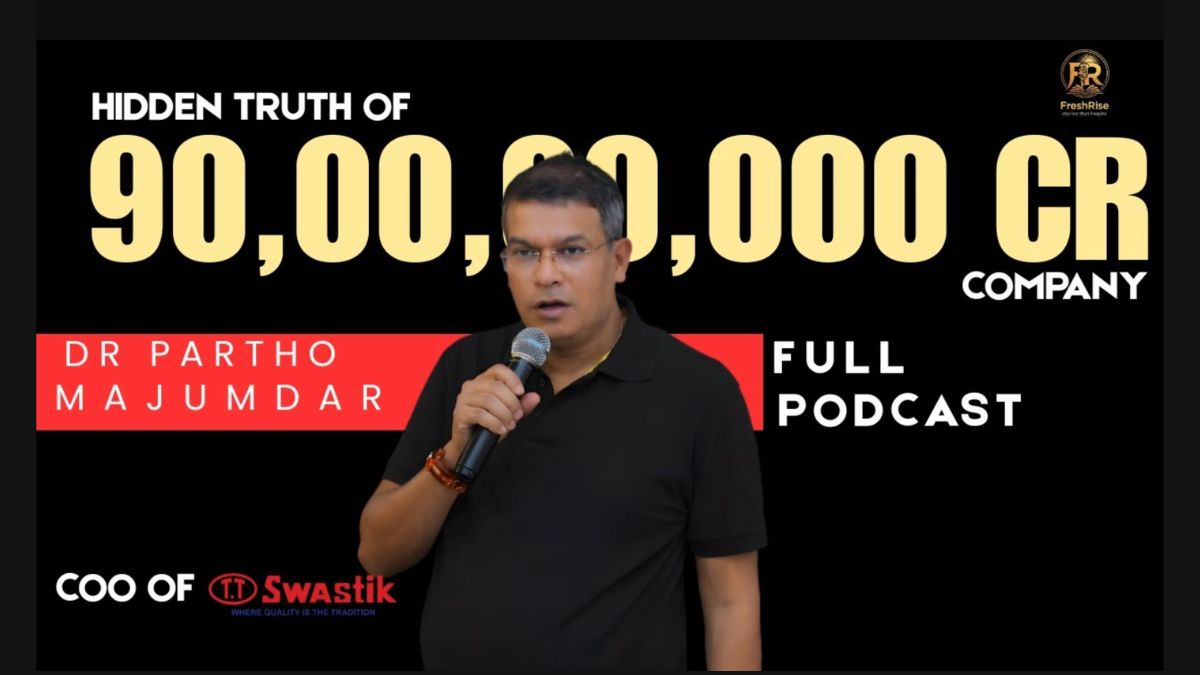
The ₹90,000 Cr Truth: Decoding the Secrets of Indian Corporate Giants
In the world of high-stakes corporate leadership, few people see the machinery of business as clearly as a COO. In a recent episode of the FreshRise Podcast, host LakshmiShree DN sat down with Dr. Partho Madumdar, the current COO of Swastik Pipes Limited. With a career spanning over three decades across plastics, finance, insurance, and metals, Dr. Madumdar didn’t hold back.
He pulled back the curtain on the “dark reality” of how some Indian companies operate, why smaller firms struggle to compete with giants like Apollo and Jindal, and the “silent loopholes” that often exist in corporate balance sheets.
The Transparency Gap: Why Most Companies Fail to Scale
One of the most jarring revelations from the podcast was Dr. Madumdar’s take on company finances. While many balance sheets look pristine from the outside, the “inside” is often a different story. He noted that out of roughly 5,000 industries in India, only a fraction are truly thriving.
The reason? A lack of transparency and a “promoter mentality” focused on siphoning funds. [07:34] He explained that many promoters intentionally complicate finances to avoid GST and corporate taxes, which ultimately stifles long-term growth. In contrast, leaders like Ratan Tata and Azim Premji built empires on the bedrock of ethical transparency. [08:42]
The “5 M’s” of Manufacturing Excellence
For any entrepreneur or blogger looking to understand the manufacturing sector, Dr. Madumdar provided a masterclass in operational efficiency. He breaks down success into five pillars, known as the 5 M’s:
-
Money: Capital for raw materials.
-
Material: Ensuring quality and supply chain reliability.
-
Manpower: Creating an “employee-friendly” environment where staff feel secure.
-
Machine: Maintaining equipment to prevent scrap and rejection.
-
Maintenance: The often-overlooked key to sustaining high production quality. [13:09]
He highlighted APL Apollo as a prime example of a company that used a clear vision and transparency to transform from a small player into a market leader, leaving competitors who refused to modernize in the dust. [11:12]
The Dark Side of the Insurance Sector
Transitioning from manufacturing to services, Dr. Madumdar shared a shocking perspective on the insurance industry. Having worked in health insurance, he described it as one of the “toughest” businesses because you are selling a promise rather than a physical product. [23:00]
He exposed a common “scam” involving the collusion between hospitals and insurance companies. [26:31] Using a personal anecdote about his son’s injury, he explained how doctors often recommend unnecessary surgeries or expensive tests (like a ₹6,000 CT scan over a ₹600 X-ray) simply because a patient has insurance. [27:45] His advice? Always seek a second opinion and don’t assume that a corporate hospital has your best interests—rather than their bottom line—at heart.
Cultural Mismatches: India vs. Europe
Having worked with international partners, Dr. Madumdar pointed out a significant cultural divide. In Italy, for example, professionals often work a 4.5-day week and finish all tasks by 5:30 PM because they are highly accountable. [33:01] In India, however, many struggle to finish the same work in 7 days due to a lack of individual accountability and a tendency toward “corporate politics.”
His leadership philosophy is simple: Speak less, hear more, and stay out of the lunchroom gossip. [17:26] By avoiding the “refresment table” talk, leaders can keep their vision clear and avoid the traps of office politics that kill productivity.
Advice for Young Investors and Entrepreneurs
When asked what red flags investors should look for in a manufacturing company, Dr. Madumdar’s answer was immediate: Inventory and Debtors. [01:16:23]
-
Fake Debtors: Watch out for companies inflating their strength through fake receivables.
-
Inventory Ratios: A healthy company should have an asset-to-creditor ratio of roughly 2:1. [01:17:04]
For those looking to enter the pipe industry, he warns that the entry ticket is high—roughly ₹50 Crores for a compliant, large-scale plant. [53:17] However, for freshers, he recommends starting with trading to understand market demand and product quality before committing to the heavy capital expenditure of manufacturing. [59:46]
The Vision for 2035: India as a Manufacturing Hub
Despite his critiques of certain corporate practices, Dr. Madumdar is incredibly bullish on India’s future. He credits government initiatives like Make in India and PLI schemes for shifting the global supply chain away from China. [01:27:20]
He envisions India becoming self-reliant in defense and semiconductors, with infrastructure growth—particularly the roads built under Nitin Gadkari—serving as the “catalyst” for an economic explosion by 2035. [01:31:41]
Final Words: The Passionate Worker
The podcast concluded with a powerful message on leadership. Dr. Madumdar believes that a true leader isn’t someone who declares themselves one, but someone whom others choose to follow. [02:14]
Whether you are managing a family of four or a factory of 400, the principles remain the same: be honest, stay transparent, and be accountable. [01:36:31]
Watch the full interview here: https://youtu.be/u2doMZiLaug
Read more:- https://freshrise.in/amaan-khan-entrepreneur-changemaker-freshrise-podcast/

The Founder of Fresh Rise and a global educator, a digital news platform focused on delivering clear, verified, and meaningful stories that matter to everyday readers. I write about current affairs, government schemes, education, social issues, and global developments, presenting complex topics in a simple and easy-to-understand format.
With a background in teaching and content creation, I believes that information should be accessible to everyone. Through Fresh Rise, i aim to help readers stay informed with factual reporting, practical insights, and timely updates.