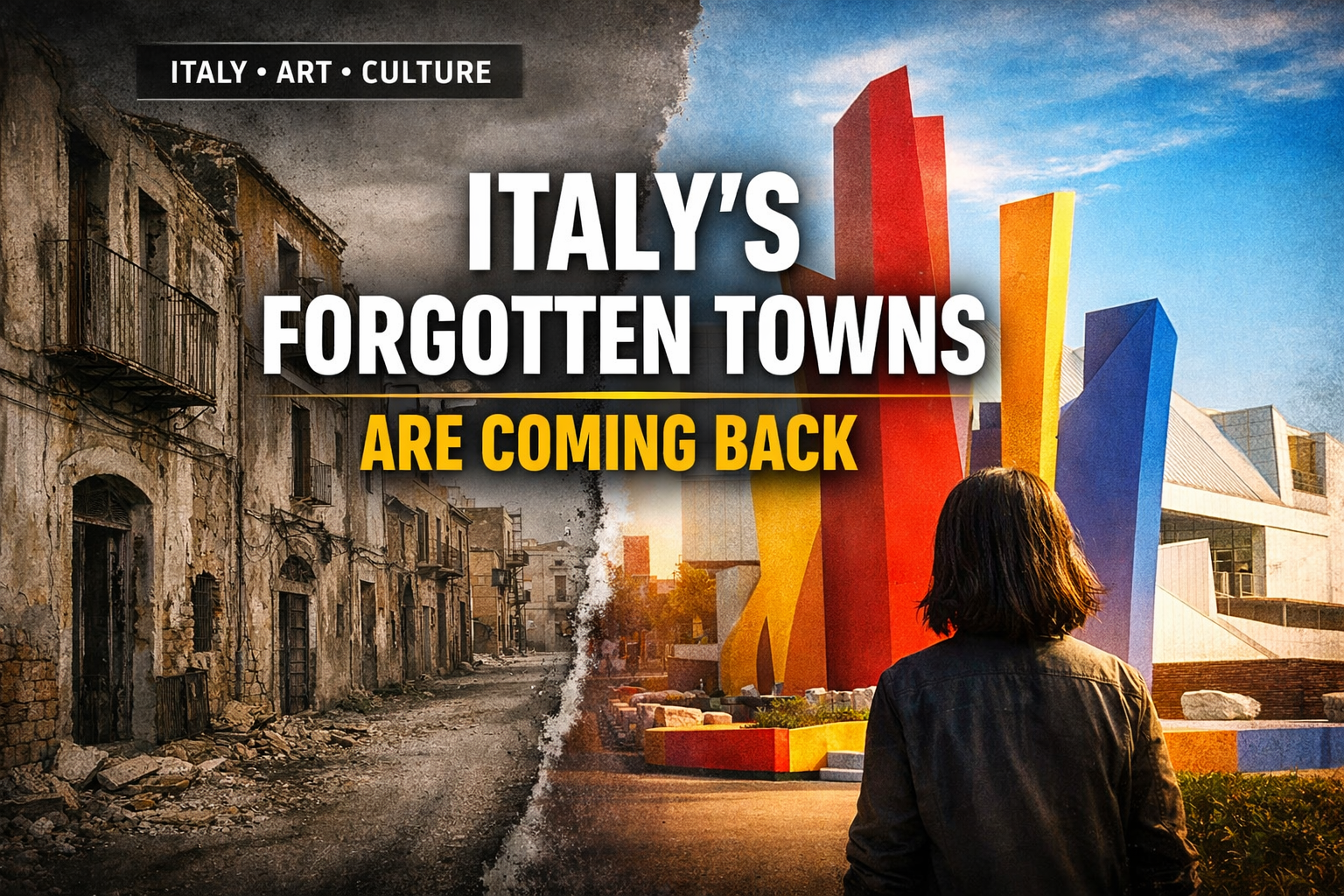
Shock, beauty, and big change now define western Sicily. Once known for abandoned towns and empty streets, this region is quietly rewriting its future. The western Sicily arts hub is emerging as one of Italy’s most unexpected cultural success stories, where art is not just decoration — it is survival.
From deserted convents to earthquake-hit towns, contemporary art is breathing life back into places many had given up on. Tourists are arriving, artists are staying, and local communities are finding hope in creativity. What’s happening here is not a trend — it’s a movement.
Western Sicily Arts Hub and the Rise of Palermo’s Hidden Art Spaces
Palermo’s streets are loud, crowded, and full of life. But behind ancient doors and forgotten buildings, something powerful is happening. Abandoned convents, storage rooms, and churches are being reborn as modern art spaces.
One such place is the former Convento dei Crociferi, now transformed into a bold museum exploring how cities change with people. This revival is part of a larger wave shaping the western Sicily arts hub, where history and contemporary ideas sit side by side.
Artists and cultural foundations are reclaiming unused spaces and giving them new purpose — without erasing the past.
How the Western Sicily Arts Hub Revived Favara from Decline
Favara was once a town people left behind.
After its sulphur mines closed, buildings crumbled and families moved away. Then came an idea that changed everything. Farm Cultural Park turned abandoned palazzos into colorful art studios, galleries, and creative cafés.
The results were stunning:
- Tourism exploded
- Jobs were created
- Artists moved in
- Local pride returned
From one small hotel to hundreds of tourist beds, Favara became proof that the western Sicily arts hub could create real economic change — not just beautiful exhibitions.
Gibellina: The Earthquake Town That Became Italy’s Art Capital
No place represents this movement better than Gibellina.
Destroyed by a devastating earthquake in 1968, the town was rebuilt with a daring idea: art would shape everyday life. Architects, sculptors, and designers were invited to imagine a city where creativity lived on the streets.
Today, that vision has been officially recognized. Gibellina is now Italy’s first Capital of Contemporary Art — a historic moment for the western Sicily arts hub.
Massive sculptures, experimental buildings, and open-air artworks turn the town into a living museum. Art here is not sold. It is shared.
Why Art Is Becoming Sicily’s New Economic Engine
This revival is not accidental.
Western Sicily faces serious challenges: depopulation, unemployment, and aging infrastructure. Art alone cannot fix everything — but it can open doors.
The western Sicily arts hub is helping to:
- Attract international visitors
- Support young creatives
- Reuse abandoned public buildings
- Preserve collective memory
Old prisons become exhibitions. Churches become studios. The past is not erased — it is respected.
Western Sicily’s transformation is not loud or flashy. It is slow, emotional, and deeply human. What makes the western Sicily arts hub so powerful is its honesty. These are not luxury projects built for outsiders only. They are community-driven spaces where memory, pain, and hope coexist. In towns like Favara and Gibellina, art is not pretending everything is perfect. It acknowledges loss — earthquakes, migration, silence — and turns those scars into meaning. Visitors don’t just look at art here. They feel it. They walk through former prisons, touch walls marked by time, and see beauty emerge from neglect. This kind of cultural revival does something rare: it gives people a reason to stay, to return, and to believe again. Children grow up seeing creativity as part of daily life. Elderly residents see forgotten places filled with voices again. It’s not just tourism growth — it’s emotional recovery. Western Sicily is showing the world that regeneration doesn’t need to erase history to move forward.
What’s unfolding now feels like a lucky moment, but it is built on decades of belief and risk. Artists, architects, and local leaders chose imagination over abandonment. The western Sicily arts hub proves that art can be infrastructure — just as important as roads or hospitals in shaping a future. As Italy and Europe search for answers to shrinking towns and empty cities, western Sicily offers a living example. This is not a finished story. It’s a beginning. New residencies, reopened civic centers, and renewed festivals are only the next chapter. And the most beautiful part? The art stays. It belongs to the place, the people, and the memory of what once was. That’s how a region heals — not by forgetting, but by creating.
The western Sicily arts hub is more than an art story. It’s good news in a world full of decline headlines. It shows what happens when creativity meets courage. If this story moved you, share it — because forgotten places deserve to be seen, and hope deserves attention.
FAQ
What is the western Sicily arts hub?
The western Sicily arts hub refers to a growing cultural movement where contemporary art is revitalizing abandoned towns, historic buildings, and earthquake-affected areas across western Sicily, including Palermo, Favara, and Gibellina.
Internal Link Suggestion
Anchor text: Italy’s cultural revival stories
External Authority Link Suggestion
Anchor text: Italian Ministry of Culture contemporary art initiatives
Read More:- https://freshrise.in/epstein-files-part-2-names-flights-hidden-clues/
Link :- https://kapublic.com/chinna-vs-real-estate-investment-analysis-kannada/
The Founder of Fresh Rise and a global educator, a digital news platform focused on delivering clear, verified, and meaningful stories that matter to everyday readers. I write about current affairs, government schemes, education, social issues, and global developments, presenting complex topics in a simple and easy-to-understand format.
With a background in teaching and content creation, I believes that information should be accessible to everyone. Through Fresh Rise, i aim to help readers stay informed with factual reporting, practical insights, and timely updates.