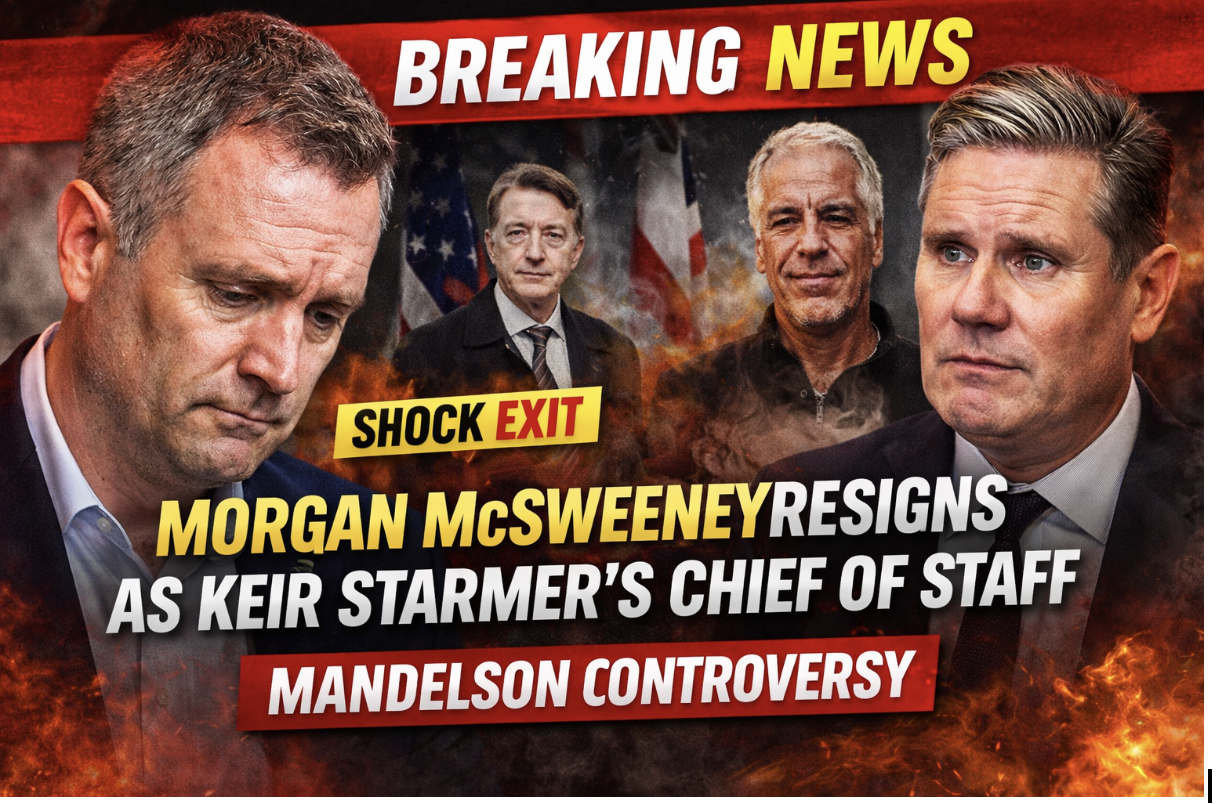
Shock waves ripped through Westminster as Morgan McSweeney resigns as Keir Starmer’s chief of staff, marking one of the most dramatic moments of the new Labour government. The resignation follows growing anger over the appointment of Peter Mandelson as US ambassador and revelations linked to Jeffrey Epstein that have shaken public trust.
For a government elected on promises of integrity and change, this moment feels heavy, emotional, and deeply symbolic.
Morgan McSweeney resigns as Keir Starmer’s chief of staff amid rising pressure
The announcement came quietly, but its impact was loud. Morgan McSweeney resigns as Keir Starmer’s chief of staff after days of mounting criticism inside and outside Labour.
McSweeney, one of Starmer’s closest and longest-serving advisers, said he took “full responsibility” for advising the prime minister to appoint Peter Mandelson as US ambassador — a decision now widely seen as politically damaging.
The release of emails highlighting Mandelson’s past relationship with convicted sex offender Jeffrey Epstein intensified the backlash. Many Labour MPs warned that the controversy risked undoing hard-won public trust just months into government.
For McSweeney, the pressure became impossible to ignore.
“The only honourable course”
In an emotional statement, McSweeney said stepping aside was necessary for the greater good.
Key lines that resonated across politics included:
- “The decision to appoint Peter Mandelson was wrong.”
- “It has damaged our party, our country and trust in politics itself.”
- “Responsibility must be owned when it matters most.”
Those words struck a nerve in a political climate where accountability often feels rare.
Why the Mandelson appointment triggered a crisis
When Peter Mandelson was named as US ambassador, concerns surfaced almost immediately. While Mandelson is a seasoned political operator, his past associations reopened painful public wounds.
The controversy escalated after:
- Emails revealed close past contact with Jeffrey Epstein
- Victims’ voices resurfaced in public debate
- MPs questioned Downing Street’s vetting process
Though McSweeney said he did not oversee the due diligence, he acknowledged advising Starmer to make the appointment — a move now widely seen as a serious misjudgment.
This is why Morgan McSweeney resigns as Keir Starmer’s chief of staff has become such a defining headline.
Remembering the real victims
One of the most powerful parts of McSweeney’s statement focused not on politics, but on people.
He urged the country to remember:
- Women and girls whose lives were destroyed
- Voices that were ignored for too long
- The moral responsibility of those in power
In doing so, he shifted the conversation from strategy to humanity — a rare and sobering moment in modern politics.
A huge loss for Keir Starmer and Labour
There is no overstating McSweeney’s importance to the Labour project. From his early work pushing back against the hard left to running the 2024 election campaign, he was central to Labour’s transformation.
Starmer himself paid tribute, saying:
- McSweeney helped turn Labour around after its worst defeat
- He played a central role in winning a landslide majority
- His dedication and loyalty were crucial to forming government
Yet despite this praise, Morgan McSweeney resigns as Keir Starmer’s chief of staff leaves a deep hole at the heart of Downing Street.
Critics inside Labour speak out
Not everyone in the party will mourn his departure. Some MPs complained that McSweeney oversaw a:
- Factional environment
- Cliquey Downing Street culture
- Heavy-handed operation
His resignation now opens the door for internal change — but also uncertainty.
The moment Morgan McSweeney resigns as Keir Starmer’s chief of staff may come to define the early chapter of this Labour government. It exposes how fragile political trust remains, even after a landslide victory built on promises of higher standards and cleaner politics.
This resignation is not just about one adviser stepping down. It is about a government being tested in real time. Labour came to power promising a “big change” — not only in policy, but in political culture. That promise is now under a harsh spotlight.
McSweeney’s words, especially his emphasis on responsibility and the victims of Epstein, struck a tone many voters have been longing to hear. But words alone are not enough. The call to overhaul vetting and due diligence processes must now become action, not symbolism.
For Starmer, losing a trusted strategist so early is a warning. Leadership is not just about loyalty; it is about judgment. How he rebuilds his inner circle, restores confidence, and responds to public anger will shape the government’s future far more than any single appointment.
This is a moment of reckoning — and an opportunity.
As Morgan McSweeney resigns as Keir Starmer’s chief of staff, Westminster is left asking deeper questions about power, accountability, and trust. Why were warning signs missed? How did such a controversial appointment pass through the system? And who ultimately pays the price when mistakes are made?
In recent years, politics has often felt disconnected from everyday lives. Scandals blur together. Apologies sound rehearsed. Resignations feel rare. That is why this moment stands out. McSweeney did not deflect blame. He did not hide behind process. He stepped aside.
Whether this becomes a turning point or just another chapter depends on what comes next. Labour voters expect more than damage control. They expect reform, transparency, and empathy.
Starmer now faces a defining challenge: prove that this government truly operates differently. That trust, once shaken, can be rebuilt through action — not just statements.
The stakes are high. The public is watching closely. And history will remember how this moment was handled.
When Morgan McSweeney resigns as Keir Starmer’s chief of staff, it sends a powerful message about responsibility in public life. In an age of political cynicism, moments like this still matter.
If this story made you think about trust, leadership, and the cost of political decisions, share it. Conversations shape democracy — and silence never fixes what is broken.
FAQ
Q: Why did Morgan McSweeney resign as Keir Starmer’s chief of staff?
Morgan McSweeney resigned after taking responsibility for advising Keir Starmer to appoint Peter Mandelson as US ambassador, a decision that sparked controversy and damaged public trust.
Read More :-https://freshrise.in/russia-general-shooting-suspect-arrested-in-dubai/
External Authority Link Suggestion
UK parliamentary standards and accountability

The Founder of Fresh Rise and a global educator, a digital news platform focused on delivering clear, verified, and meaningful stories that matter to everyday readers. I write about current affairs, government schemes, education, social issues, and global developments, presenting complex topics in a simple and easy-to-understand format.
With a background in teaching and content creation, I believes that information should be accessible to everyone. Through Fresh Rise, i aim to help readers stay informed with factual reporting, practical insights, and timely updates.