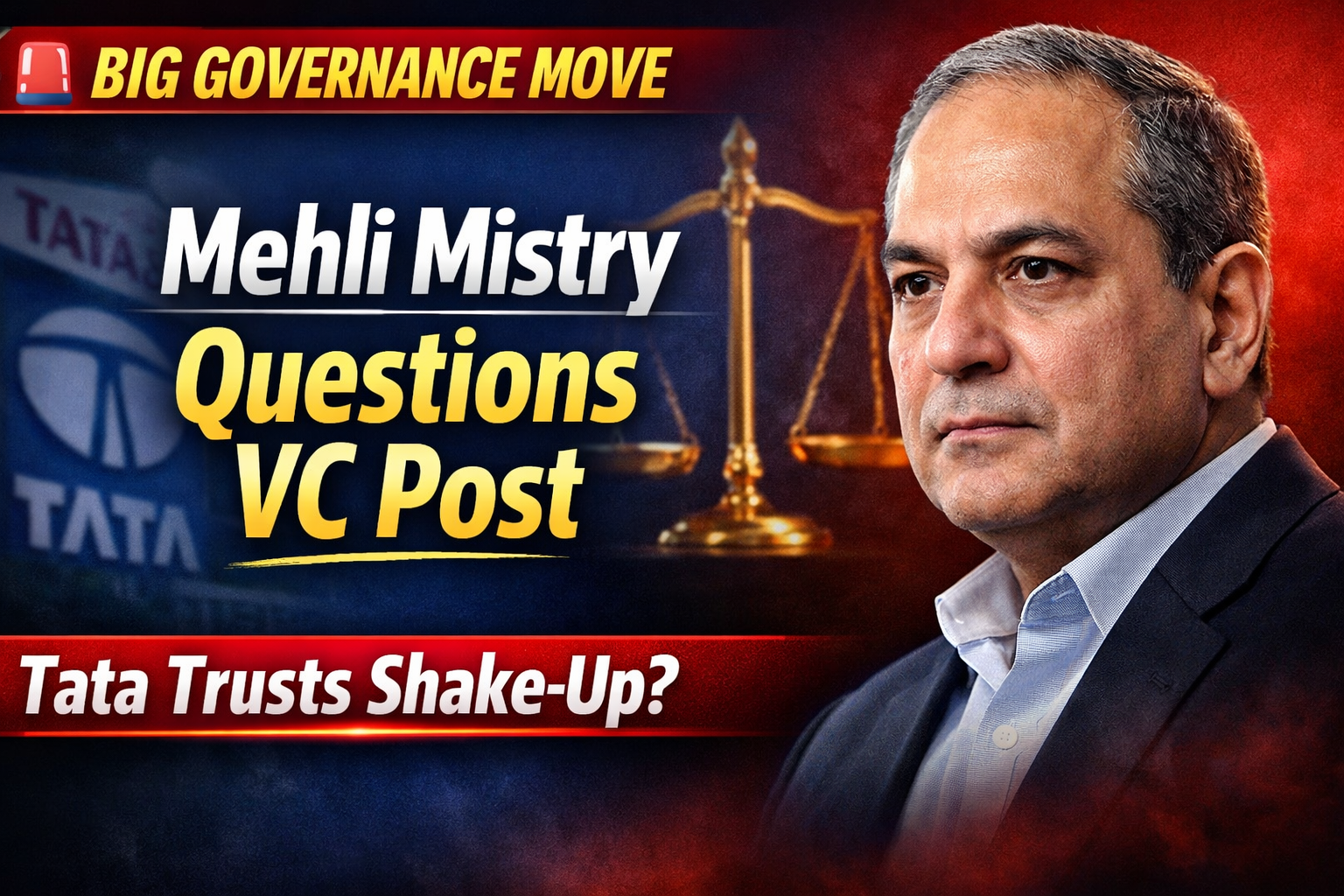
Mehli Mistry seeks scrapping of VC position at Tata Trusts — and the move has sent shockwaves across India’s corporate and philanthropic circles. In what many are calling a bold and unexpected step, the respected trustee has questioned the very existence of the vice-chairman role within the powerful Tata Trusts structure.
The issue is not just about a title. It is about governance, legacy, and the interpretation of the Trust Deed that defines how one of India’s most influential charitable institutions should function.
At a time when transparency and accountability are under the spotlight globally, this development feels like a big change moment for Tata Trusts.
Why Mehli Mistry Seeks Scrapping of VC Position at Tata Trusts
The core of the controversy lies in one powerful argument: the Trust Deed does not provide for the position of vice-chairman.
According to people familiar with the discussions, Mehli Mistry, a trustee on the board of Tata Education and Development Trust (TEDT), believes that the role has no legal foundation within the governing document of the Trust.
Key Concerns Raised
- The vice-chairman position is not mentioned in the original Trust Deed.
- The role was introduced during a previous period of internal legal conflict.
- The title, in its current form, may lack operational clarity and purpose.
For Mistry, the issue is not personal. It is structural. He reportedly considers the titles “meaningless” in their present form if they do not align with the foundational document.
This raises a larger question: Should governance structures evolve beyond original deeds, or must they strictly adhere to them?
Governance Alert: A Big Moment for Tata Trusts
When Mehli Mistry seeks scrapping of VC position at Tata Trusts, it is more than a procedural suggestion. It signals a governance alert.
Tata Trusts is not just another institution. It is the philanthropic heart of the Tata Group, holding significant stakes in Tata Sons and influencing strategic decisions. Any internal governance debate within the Trust has ripple effects across India’s business ecosystem.
Why This Matters
- Tata Trusts owns a substantial stake in Tata Sons.
- Governance decisions influence the broader Tata Group.
- Public trust in the institution is deeply tied to transparency.
This is why observers see this as a potentially defining moment.
The vice-chairman role was reportedly introduced during a tense phase in the past, when legal battles and leadership questions dominated headlines. Now, years later, the relevance of that role is being reassessed.
Is it still needed? Or was it a temporary solution that became permanent?
Understanding the Trust Deed and Its Importance
The Trust Deed is not just a formal document. It is the guiding constitution of Tata Trusts.
When Mehli Mistry seeks scrapping of VC position at Tata Trusts, his argument rests heavily on this foundational text. If the Trust Deed does not explicitly authorize a vice-chairman role, should such a position exist?
The Role of the Trust Deed
- Defines powers and responsibilities of trustees.
- Establishes governance structure.
- Protects institutional integrity.
- Ensures continuity of founder’s vision.
For institutions with deep legacy roots like Tata Trusts, adherence to the Trust Deed is often seen as preserving the founder’s intent.
Any deviation — even if practical — can invite scrutiny.
The Emotional Undercurrent Behind the Debate
This is not just a technical governance issue. It touches legacy, reputation, and institutional credibility.
Tata Trusts has long been viewed as a symbol of ethical leadership in India. The brand carries emotional weight. Millions associate it with trust, stability, and nation-building.
That is why the news that Mehli Mistry seeks scrapping of VC position at Tata Trusts feels significant.
It brings back memories of past internal conflicts that once dominated headlines. It also reminds stakeholders that governance reforms are ongoing — and sometimes uncomfortable.
But discomfort can also be a sign of healthy institutional introspection.
What Happens Next?
As of now, discussions are ongoing. There is no official public statement confirming structural changes.
However, insiders suggest that the matter is being examined seriously at the trustee level.
Possible outcomes include:
- Formal review of the Trust Deed.
- Amendment proposals.
- Clarification of vice-chairman powers.
- Complete removal of the role.
For readers who follow Tata developments closely, you may also want to revisit our coverage on Tata Trusts governance reforms (internal link suggestion).
For deeper context on charitable trust governance frameworks in India, readers can refer to the official Ministry of Corporate Affairs website (external authority link suggestion).
A Larger Reflection on Leadership and Accountability
The fact that Mehli Mistry seeks scrapping of VC position at Tata Trusts speaks volumes about the evolving standards of governance in India’s top institutions.
Corporate and charitable governance is no longer a silent internal matter. Today’s stakeholders — from employees to investors to beneficiaries — expect clarity. Titles must have meaning. Positions must have legitimacy. Structures must align with foundational documents.
If the vice-chairman role was created during a period of conflict, then perhaps it served its purpose at that time. But institutions mature. They reassess. They refine.
This moment could mark a transition from reactive governance to principle-based governance.
And that is good news for those who value institutional integrity.
In many ways, this debate is not about a vice-chairman title at all.
It is about how legacy institutions adapt while staying true to their roots. It is about whether temporary arrangements become permanent fixtures without proper constitutional backing. It is about the courage to question structures — even when those structures are powerful and long-standing.
When Mehli Mistry seeks scrapping of VC position at Tata Trusts, he is effectively asking a simple but powerful question: Does this align with the Trust Deed?
If the answer is no, then change becomes not just an option, but a responsibility.
This conversation may feel technical, but its implications are emotional and symbolic. Tata Trusts represents decades of philanthropy, education support, healthcare initiatives, and nation-building. Governance clarity ensures that this legacy remains strong for future generations.
And perhaps that is the real story here — not conflict, not controversy, but course correction.
As India watches closely, one thing is clear: Mehli Mistry seeks scrapping of VC position at Tata Trusts has opened a serious and necessary conversation.
Change in legacy institutions is never easy. It brings tension, debate, and headlines. But sometimes, those moments lead to stronger systems and renewed public confidence.
If you care about governance, corporate ethics, and the future of India’s most respected institutions, this is a story worth following.
Share this article with your network and join the conversation. Big changes often begin with bold questions.
FAQ
Why does Mehli Mistry seek scrapping of VC position at Tata Trusts?
Mehli Mistry seeks scrapping of VC position at Tata Trusts because he reportedly believes the role is not provided for in the Trust Deed. His concern is that governance structures must align with the foundational legal document that defines how Tata Trusts operates.
Read More:- https://freshrise.in/netanyahu-to-push-trump-on-iran-missiles-in-white-house-talks/
Link:- https://kapublic.com/https-kapublic-com-p601previewtrue/#more-601

The Founder of Fresh Rise and a global educator, a digital news platform focused on delivering clear, verified, and meaningful stories that matter to everyday readers. I write about current affairs, government schemes, education, social issues, and global developments, presenting complex topics in a simple and easy-to-understand format.
With a background in teaching and content creation, I believes that information should be accessible to everyone. Through Fresh Rise, i aim to help readers stay informed with factual reporting, practical insights, and timely updates.