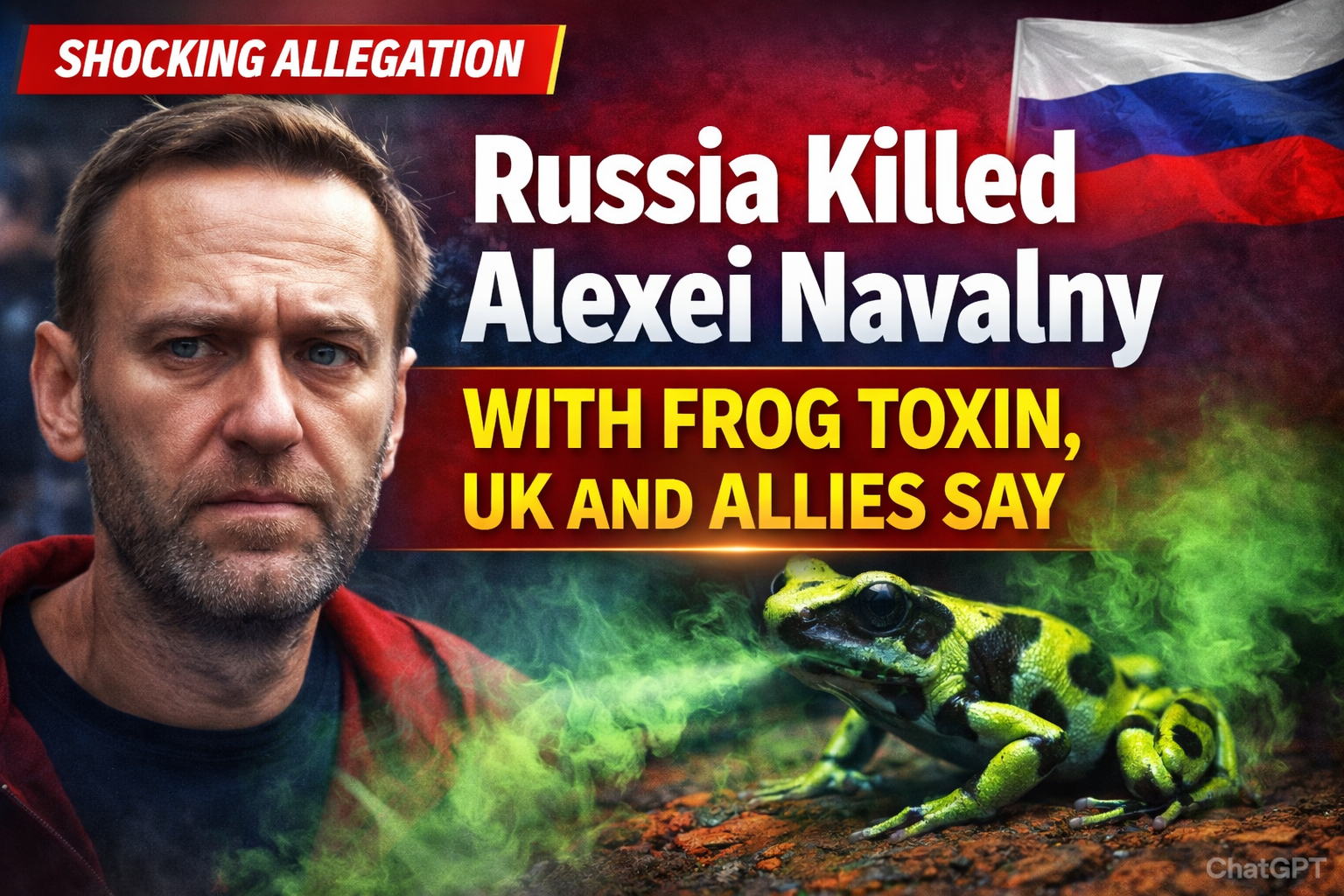
Russia killed Alexei Navalny with frog toxin, UK and allies say — this explosive claim has sent shockwaves across Europe and beyond. Two years after the sudden death of Russian opposition leader Alexei Navalny in an Arctic penal colony, a new intelligence statement alleges he was poisoned with a rare toxin found in Ecuadorian dart frogs.
The announcement, released jointly by the UK, France, Germany, Sweden, and the Netherlands, has reignited global anger. It also raises serious questions about chemical weapons and international law.
The world is watching again.
Russia Killed Alexei Navalny With Frog Toxin, UK and Allies Say: What the Report Claims
According to the joint statement, laboratory tests conducted on samples taken from Navalny’s body detected epibatidine, a powerful toxin found in the skin of certain South American dart frogs.
Officials claim:
-
The toxin does not occur naturally in Russia
-
Dart frogs in captivity do not produce it
-
There is “no innocent explanation” for its presence
-
Only the Russian state had the means, motive, and opportunity
The UK described the alleged poisoning as “barbaric” and announced it would report Russia to the Organisation for the Prohibition of Chemical Weapons (OPCW), citing a violation of the Chemical Weapons Convention.
The statement makes it clear: Russia killed Alexei Navalny with frog toxin, UK and allies say, and they hold the Russian state directly responsible.
Who Was Alexei Navalny?
Alexei Navalny was one of the strongest critics of Russian President Vladimir Putin. He built a massive anti-corruption movement and became a symbol of political resistance in Russia.
Navalny survived a previous poisoning attempt in 2020, widely believed to involve a nerve agent. After returning to Russia, he was arrested and sentenced to 19 years in prison.
In 2024, he died at age 47 in a remote Arctic penal colony while serving that sentence.
At the time, Moscow said his death resulted from a mixture of illnesses.
Now, the new intelligence claim challenges that version entirely.
Epibatidine: The Deadly Frog Toxin Explained
The substance identified in the report is epibatidine — a rare and highly toxic chemical naturally found in the skin of certain Ecuadorian dart frogs.
Experts say it can cause:
-
Paralysis
-
Respiratory failure
-
Severe pain
-
Rapid death
Unlike many common toxins, epibatidine is not naturally present in Russia. Intelligence agencies argue this makes its alleged use deliberate and calculated.
The report states that the toxin was detected in samples secured before Navalny’s burial and analyzed by two separate laboratories.
If confirmed, this would represent a chilling escalation in alleged state-sponsored poisonings.
A Pattern of Poisoning Allegations
The claim that Russia killed Alexei Navalny with frog toxin, UK and allies say comes against the backdrop of previous high-profile poison cases.
Among them:
-
The 2006 death of Alexander Litvinenko in London from radioactive polonium
-
The 2018 nerve agent attack on Sergei Skripal in Salisbury
-
The earlier poisoning attempt on Navalny himself
The UK has repeatedly accused Moscow of using toxins as a tool against political opponents and defectors.
Russia denies these allegations.
Yulia Navalnaya’s Emotional Response
Navalny’s widow, Yulia Navalnaya, reacted strongly to the findings.
In a public statement, she said the poison causes paralysis and respiratory arrest, and added:
“Putin killed Alexei with a chemical weapon.”
She thanked European states for their two-year investigation and vowed that justice would come.
Her speech at the Munich Security Conference in 2024 was emotional and direct. She said those responsible would eventually be punished.
Her message was clear: accountability must follow.
Why This Announcement Matters Now
The intelligence findings were released during the Munich Security Conference, nearly two years after Russia first announced Navalny’s death as the conference began.
Observers say the timing is symbolic.
The UK Foreign Secretary, Yvette Cooper, stated that only the Russian government had the means, motive, and opportunity.
She called the alleged act a “barbaric plot” to silence opposition.
If the claim that Russia killed Alexei Navalny with frog toxin, UK and allies say leads to formal international action, it could mark a significant diplomatic shift.
Global Impact and What Comes Next
The UK says it will formally raise the case with the OPCW. This could lead to international investigations, sanctions, or legal proceedings.
There are also growing calls for:
-
Independent forensic review
-
Expanded sanctions
-
Greater scrutiny of chemical weapons compliance
-
Increased diplomatic pressure
For background on chemical weapons regulations, readers can refer to the official OPCW website .
For more international political updates, you may also read our related analysis on global diplomatic tensions .
The allegation that Russia killed Alexei Navalny with frog toxin, UK and allies say does more than revisit a tragic death. It reshapes how the world sees political dissent inside Russia.
Navalny represented hope to many Russians who believed in transparency and accountability. His investigations exposed corruption. His speeches inspired thousands.
His imprisonment was controversial. His death was devastating. Now, this new intelligence claim deepens that tragedy.
If the use of a rare toxin is proven, it suggests not just suppression — but extreme measures.
Internationally, this may intensify diplomatic isolation. Domestically, it may strengthen opposition narratives.
The Kremlin denies wrongdoing. But the story is far from over.
Justice, Memory, and the Search for Truth
Two years have passed since Navalny’s death in an Arctic prison. His supporters still gather. His wife continues speaking. His name remains powerful.
The claim that Russia killed Alexei Navalny with frog toxin, UK and allies say adds a new chapter — one filled with scientific detail, diplomatic tension, and emotional weight.
For his supporters, this is not just about a toxin. It is about justice.
It is about accountability.
And it is about remembering a man who chose to return to his country despite the risks.
Whether international institutions act decisively remains to be seen. But one thing is certain — this case has reignited global debate about political freedom, chemical weapons, and state responsibility.
The words Russia killed Alexei Navalny with frog toxin, UK and allies say carry heavy meaning. They are not just a headline. They are a global alert.
A reminder that political courage can come at a high price.
A reminder that truth often takes years to uncover.
As investigations continue and diplomatic tensions rise, the world waits for clarity, justice, and accountability.
If you believe in transparency and freedom of expression, share this story. Let others know what is unfolding.
History is watching.
FAQ
Q1: Is it confirmed that Russia killed Alexei Navalny with frog toxin, UK and allies say?
A joint intelligence statement from the UK, France, Germany, Sweden, and the Netherlands claims laboratory evidence found a rare frog toxin in Navalny’s body. Russia denies the allegation. The matter may now be raised before international bodies for further investigation.
Read More:- https://freshrise.in/dt-rachna-parashar-poshan-pushpa-story-she-lost-her-mother-then-changed-20000-lives/
Link:- https://kapublic.com/https-kapublic-com-p639previewtrue/

The Founder of Fresh Rise and a global educator, a digital news platform focused on delivering clear, verified, and meaningful stories that matter to everyday readers. I write about current affairs, government schemes, education, social issues, and global developments, presenting complex topics in a simple and easy-to-understand format.
With a background in teaching and content creation, I believes that information should be accessible to everyone. Through Fresh Rise, i aim to help readers stay informed with factual reporting, practical insights, and timely updates.