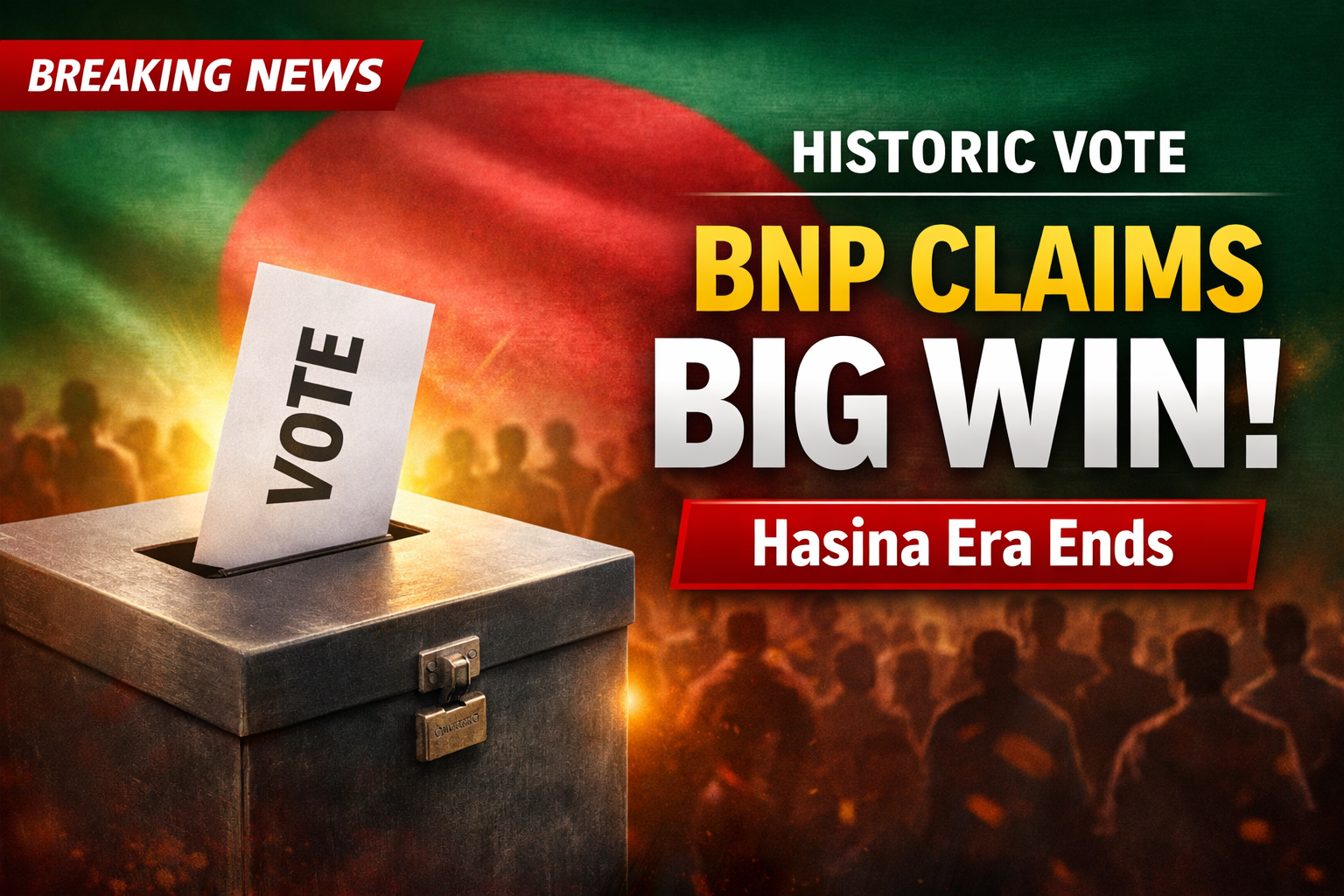
A Shock and a Big Change for Bangladesh
The Bangladesh election has delivered what many are calling a historic and emotional turning point. In the country’s first vote since the dramatic overthrow of Sheikh Hasina, the Bangladesh Nationalist Party (BNP) has claimed a sweeping victory.
For millions, this is more than just an election result.
It feels like the start of a new chapter.
After years of political tension, allegations of rigging, and violent unrest that left around 1,400 people dead according to the UN, voters turned out in large numbers. This time, the mood was different. Hope replaced fear. Participation replaced silence.
And now, the world is watching what happens next.
Bangladesh Election Results Signal Major Political Shift
The Bangladesh election results began pouring in late at night. By 4am local time, BNP had secured 185 seats in the 300-member Jatiya Sangsad — comfortably crossing the halfway mark.
Party leaders quickly declared victory.
Tarique Rahman, son of former Prime Minister Khaleda Zia and former President Ziaur Rahman, is set to lead the new government. BNP leaders even suggested they may cross the 200-seat mark, calling it a potential “landslide.”
This marks the first truly competitive Bangladesh election in more than 17 years.
Under Hasina’s rule, previous polls were widely criticized for:
-
Ballot stuffing
-
Opposition harassment
-
Jailing of political rivals
-
Suppression of media
This time, international observers and early reports described the process as largely peaceful.
Voter turnout reached 60.69%, a major jump from the 42% recorded in the previous election. Postal votes saw an impressive 80.11% participation rate — including overseas diaspora voters for the first time.
That alone signals something powerful: people wanted their voices heard.
Bangladesh Election After Gen Z Uprising
The Bangladesh election cannot be separated from the student-led uprising that reshaped the nation.
Young protesters, many from Gen Z, took to the streets demanding fairness, accountability, and democracy. The crackdown that followed was brutal. Human rights groups documented disappearances, torture, and secret detentions.
Eventually, the pressure became too much.
Sheikh Hasina fled to India after a war crimes tribunal sentenced her to death for crimes against humanity during the final days of her rule. Her departure shocked South Asia and strained ties between Dhaka and New Delhi.
In a statement after voting ended, Hasina called the election a “farce” and demanded cancellation. But the mood inside Bangladesh told a different story.
This election felt different.
For many citizens, it was a vote not just against a party — but against fear.
What BNP Promised Voters
BNP’s campaign focused on economic revival and democratic reforms.
Their key promises include:
-
Financial aid for poor families
-
A 10-year limit for any individual to remain prime minister
-
Anti-corruption measures
-
Increased foreign investment
-
Economic recovery for key sectors like garments
Bangladesh’s garment industry — the second-largest exporter globally — suffered during months of unrest. Stability is now seen as essential.
BNP leaders have also supported constitutional reforms proposed in a referendum held alongside the election. These reforms may include:
-
A neutral interim government during election periods
-
A bicameral parliament
-
Increased women’s representation
-
Judicial independence
-
A two-term limit for the prime minister
The results of the referendum are still awaited.
Opposition Reaction in Bangladesh Election
The main rival party, Jamaat-e-Islami, led by Shafiqur Rahman, conceded defeat after winning 56 seats.
Rahman said his party would practice “positive politics” rather than oppose for the sake of it.
Meanwhile, Hasina’s Awami League was barred from contesting this Bangladesh election entirely.
That fact remains controversial.
More than 2,000 candidates from 50 parties contested seats — a national record. One constituency’s voting was postponed after a candidate died.
Despite tensions, election day remained largely peaceful.
And that alone feels like good news.
A Nation at a Crossroads
This Bangladesh election represents more than a party victory. It represents a crossroads for a Muslim-majority nation of 175 million people.
The challenges ahead are massive.
BNP inherits:
-
Economic slowdown
-
Fractured diplomatic ties with India
-
Growing Chinese influence
-
Deep scars from political violence
-
Public distrust in institutions
But it also inherits something rare — public goodwill.
For the first time in years, citizens feel they made a real choice.
The United States Embassy was quick to congratulate BNP on what it called a “historic” victory. Global powers are watching closely. Bangladesh’s geographic position makes it strategically important in South Asia.
The coming months will test whether this big change translates into real reform.
What This Bangladesh Election Means for Democracy
The Bangladesh election may be remembered as a democratic reset.
For nearly two decades, critics described elections as staged and institutions weakened. Press freedom suffered. Judicial independence was questioned. Thousands disappeared.
Now, expectations are sky-high.
BNP leaders themselves warned supporters not to celebrate too soon. “This is not a time for celebration,” said Salahuddin Ahmed, a senior party member.
He’s right.
Winning an election is one thing. Rebuilding a nation is another.
If BNP follows through on constitutional reforms — especially term limits and caretaker governments — it could reshape Bangladesh’s political culture for generations.
If not, disappointment could return quickly.
For deeper political analysis, readers can explore our related coverage on South Asian democratic transitions (internal link suggestion: Read our analysis on South Asia’s political turning points).
For international human rights context, reports from the United Nations provide additional insight (external authority suggestion: United Nations human rights updates).
The Emotional Weight of This Moment
For ordinary citizens, this Bangladesh election carries emotional weight that goes far beyond numbers.
Families who lost loved ones during the uprising watched results through tears. Students who once marched in fear now talk about opportunity. Business owners hope for stability. Farmers hope for support. Women’s groups hope for stronger representation.
The air feels different.
But hope can be fragile.
BNP must balance reform with stability. It must reassure investors while addressing social inequality. It must strengthen institutions without repeating the mistakes of the past.
The world has seen many revolutions fail after victory.
Bangladesh cannot afford that.
A New Beginning or Another Chapter?
The Bangladesh election has shocked observers, energized voters, and reopened debate about democracy in South Asia.
This is a big change moment.
But real democracy is not built in a single vote. It is built day by day, decision by decision.
If this new government delivers transparency, accountability, and inclusion, the Bangladesh election will be remembered as a turning point. If promises fade, frustration could return just as quickly.
For now, the message from voters is clear: they want fairness, stability, and dignity.
History will judge what comes next.
If you found this update helpful, share it with others and join the conversation about the future of democracy in South Asia.
FAQ
What makes this Bangladesh election historic?
This Bangladesh election is considered historic because it was the first competitive and largely peaceful vote in over 17 years, following the overthrow of Sheikh Hasina’s long-standing government and a nationwide student-led uprising.
Read More:- https://freshrise.in/epstein-files-part-5-names-inside-documents/
The Founder of Fresh Rise and a global educator, a digital news platform focused on delivering clear, verified, and meaningful stories that matter to everyday readers. I write about current affairs, government schemes, education, social issues, and global developments, presenting complex topics in a simple and easy-to-understand format.
With a background in teaching and content creation, I believes that information should be accessible to everyone. Through Fresh Rise, i aim to help readers stay informed with factual reporting, practical insights, and timely updates.