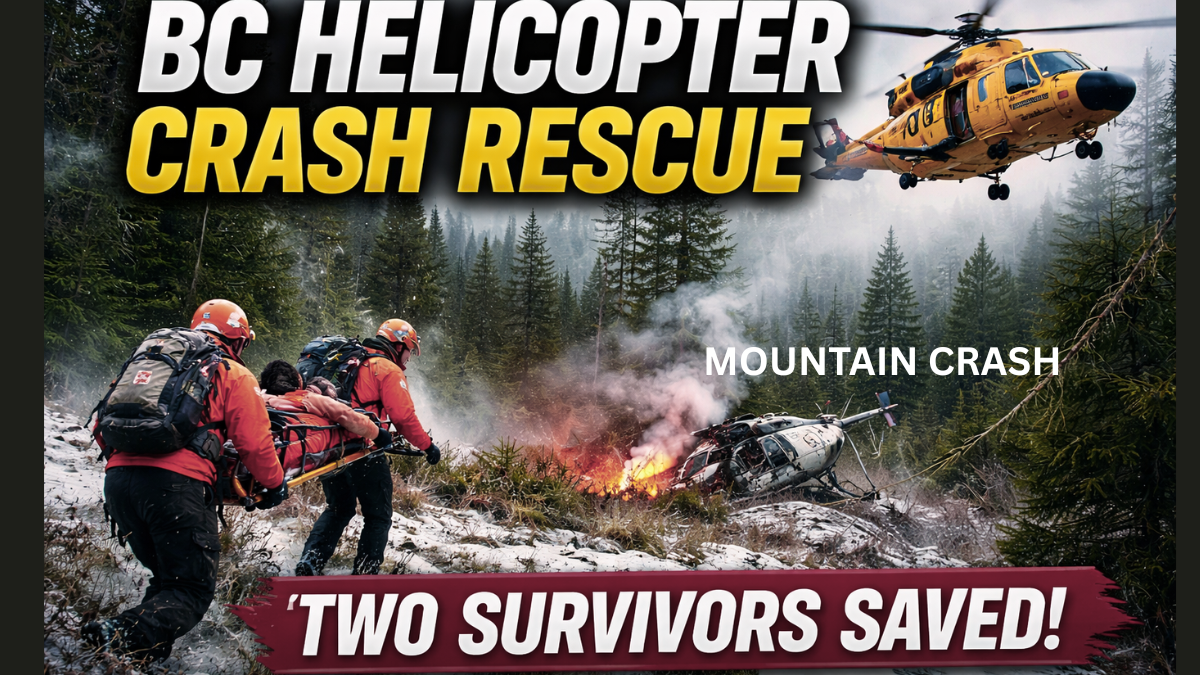
BC helicopter crash rescue:- Two people are alive today because of quick action, strong teamwork, and brave rescue crews after a helicopter crash in British Columbia’s Interior on Friday morning.
The crash happened near Mount Kubin, about 15 kilometres northwest of the city of Nelson. The area is mountainous, remote, and known for unpredictable weather. What could have turned into a tragedy became a powerful story of cooperation between military crews, local volunteers, and emergency responders.
BC helicopter crash rescue: Crash Reported Early in the Morning
According to officials, the helicopter crash was reported just after 8 a.m. on Friday. As soon as the call for help came in, a major rescue response was launched.
The Royal Canadian Air Force quickly stepped in. Crews from 19 Wing Comox were alerted and dispatched aircraft to the scene.
Two military aircraft were sent:
-
A CH-149 Cormorant helicopter
-
A CC-295 Kingfisher airplane
The Kingfisher flew overhead to provide support and monitor the situation from above. The Cormorant helicopter moved in closer to try to rescue the injured people.
Weather Creates Major Challenges
But the rescue was not simple.
The crash site was covered in low clouds. Visibility was poor. The helicopter crew could not safely reach the two injured people directly because of the heavy cloud cover and difficult mountain terrain.
Captain Matt Welsh, who was commanding the Cormorant helicopter, later explained that weather and cloud cover were among the biggest challenges during the mission.
In mountain areas like this, weather can change quickly. Low clouds can block visibility, making it dangerous for helicopters to land or hover safely.
Instead of giving up, the rescue teams changed their plan.
Ground Teams Step In
When air access became difficult, local help stepped forward.
Volunteers from Nelson Search and Rescue joined the operation. A local helicopter tour operator also assisted in coordinating efforts.
Search and rescue volunteers hiked into the remote crash site on foot. This is not an easy task. The area around Mount Kubin is steep and rugged. Carrying rescue equipment while climbing through uneven terrain requires training and strength.
After reaching the crash survivors, the volunteers assessed their condition and prepared them for evacuation.
Toboggan Used for Evacuation
Since the helicopter could not land directly at the crash location, the ground team used a toboggan to move the injured individuals to a lower elevation.
A rescue toboggan is a special sled designed to safely transport injured people over snow or rough terrain. It allows rescuers to move patients carefully while protecting them from further injury.
The volunteers carefully transported the two patients downhill until they reached a location where the Cormorant helicopter could safely access them.
This step was critical. Without the ground team’s effort, the rescue might have been delayed much longer.
Medical Evacuation to Hospital
Once the patients reached a safer location, the Cormorant helicopter took over.
One of the injured individuals was flown directly to Kelowna for further medical care. The helicopter performed a medical evacuation, often called a “medevac,” to ensure the patient reached a hospital quickly.
The second patient was transported by Nelson Search and Rescue teams to the airport in Nelson. There, crews from BC Emergency Health Services were waiting.
In a statement, BC Emergency Health Services confirmed that paramedics were dispatched to meet the rescue teams. They provided emergency treatment and transported one patient to hospital for further care.
Officials did not release details about the medical condition of the two survivors. However, both were alive and receiving treatment.
Strong Collaboration Praised
After the operation, officials praised the teamwork that made the rescue successful.
Anna Wynne, manager of Nelson Search and Rescue, described the mission as a strong collaboration between civil agencies, military crews, and commercial operators. She said everyone worked together smoothly to ensure a positive outcome.
Captain Welsh also highlighted the coordination between air and ground teams. Without clear communication and cooperation, rescues in such difficult environments can become extremely dangerous.
Once the rescue was complete, both the Cormorant helicopter and the Kingfisher aircraft returned to 19 Wing Comox.
How Search and Rescue Works in Canada
Canada has one of the largest search and rescue regions in the world. It covers mountains, forests, coastlines, lakes, and Arctic areas.
The Royal Canadian Air Force plays a major role in responding to air and marine emergencies. Specially trained crews are available 24 hours a day, seven days a week.
The CH-149 Cormorant helicopter is built specifically for search and rescue missions. It can hover in difficult conditions, lower rescue technicians on cables, and carry injured patients.
The CC-295 Kingfisher airplane is used to search large areas quickly from above. It helps locate crash sites and guide helicopters to the correct position.
But military aircraft are only part of the system.
Local volunteer search and rescue teams are equally important. Groups like Nelson Search and Rescue train regularly for mountain rescues, medical emergencies, and disaster response. They often reach victims first when terrain makes helicopter access difficult.
Provincial ambulance services, such as BC Emergency Health Services, complete the final stage of rescue by providing hospital transport and medical care.
This combined system ensures that help can reach even the most remote places in Canada.
A Reminder of Mountain Risks
This helicopter crash is also a reminder of the risks involved in flying through mountainous areas.
Mountains can create sudden weather changes. Low clouds, fog, and wind patterns can shift quickly. Even experienced pilots can face unexpected challenges.
Investigations into the cause of the crash are expected, though officials have not yet released details about what led to the incident.
For now, the focus remains on recovery and gratitude that both people survived.
A Story of Hope
In difficult moments like this, what stands out most is the human effort behind the rescue.
Volunteers hiking through rough terrain.
Military pilots navigating through cloud cover.
Paramedics waiting on standby at the airport.
Each group played a role in saving two lives.
This rescue shows how preparation, training, and teamwork can turn a dangerous situation into a story of survival.
While the crash itself was alarming, the outcome brings relief. Two people who could have been lost in the mountains were instead brought safely to medical care.
As weather challenges continue to test rescue teams across Canada’s vast landscapes, stories like this remind us of the dedication of those who serve quietly in the background — ready to respond at a moment’s notice.
The quick coordination between the Royal Canadian Air Force, local volunteers, and emergency health services ensured that what began as a frightening crash ended with hope and survival.
Further updates may follow as more information becomes available. For now, the message is clear: teamwork saved lives in the mountains of British Columbia.

The Founder of Fresh Rise and a global educator, a digital news platform focused on delivering clear, verified, and meaningful stories that matter to everyday readers. I write about current affairs, government schemes, education, social issues, and global developments, presenting complex topics in a simple and easy-to-understand format.
With a background in teaching and content creation, I believes that information should be accessible to everyone. Through Fresh Rise, i aim to help readers stay informed with factual reporting, practical insights, and timely updates.