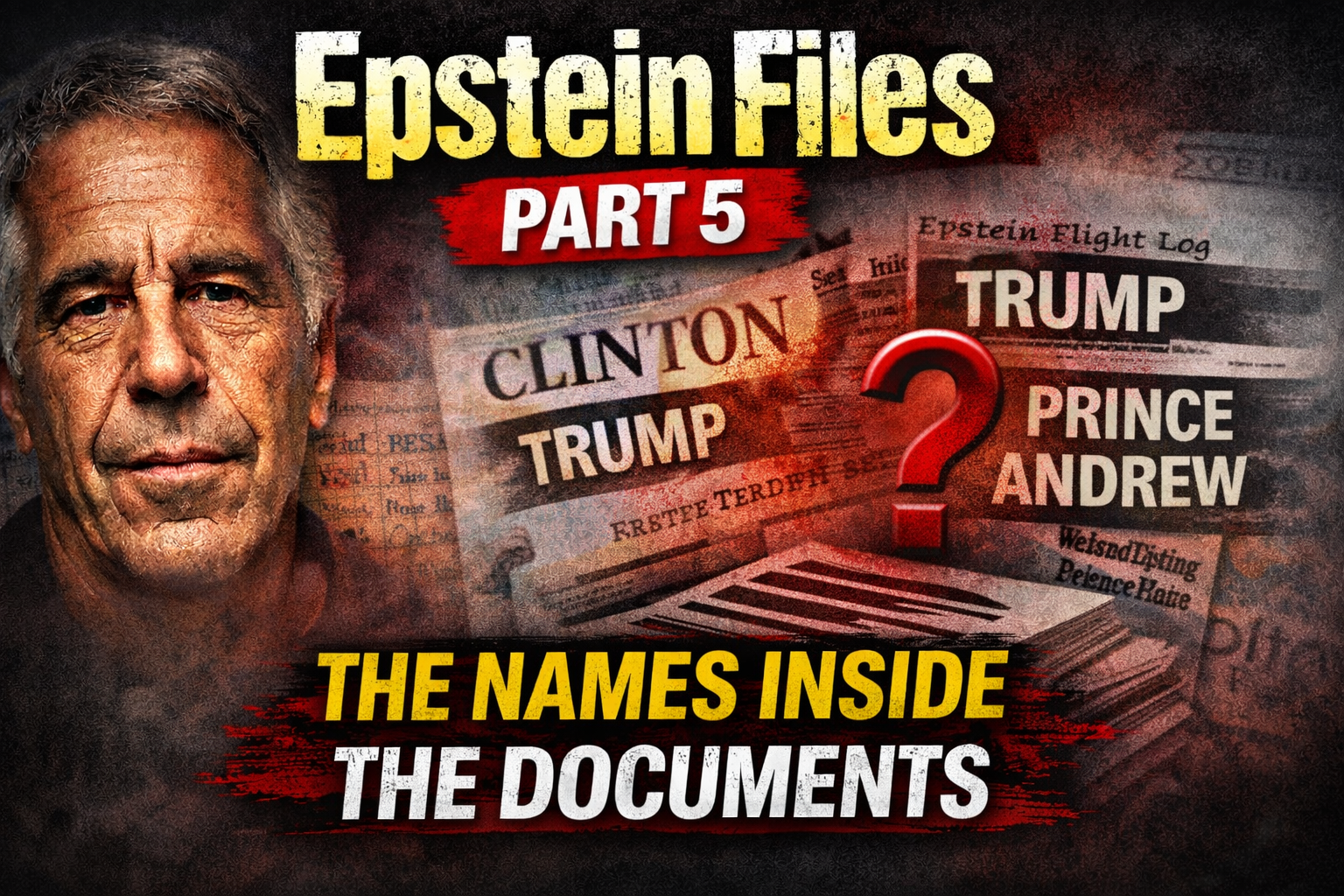
This is the chapter many people have been waiting for.
The Epstein Files contain names.
Famous names.
Powerful names.
Unexpected names.
But here is the truth most headlines don’t explain:
A name appearing in the Epstein Files does not automatically mean guilt.
Epstein Files Part 5 is about separating facts from assumptions — and understanding what those names really represent.
Epstein Files and the Difference Between Mention and Accusation
The Epstein Files include:
- Flight logs
- Address books
- Email contacts
- Legal depositions
- Witness testimony
A name can appear for many reasons:
- Social contact
- Business meeting
- Travel record
- Testimony reference
Being mentioned is not the same as being charged.
This distinction matters.
Epstein Files and Publicly Reported High-Profile Associations
Several high-profile figures were publicly documented as having social or professional associations with Jeffrey Epstein over the years. These associations were reported widely by international media and acknowledged in various ways.
Some individuals publicly confirmed past contact but denied knowledge of wrongdoing. Others stated they cut ties after concerns emerged. A few faced lawsuits or investigations, while many were never accused of crimes.
The Epstein Files show that Epstein cultivated relationships strategically.
Access to power increased his protection.
But documentation of contact does not equal criminal responsibility.
Why Epstein Collected Powerful Contacts
The Epstein Files suggest a pattern:
- Building influence
- Creating leverage
- Expanding credibility
Having prominent names in a contact book can serve many purposes. It signals status. It builds trust. It discourages scrutiny.
This does not automatically mean those contacts participated in wrongdoing.
But it shows how proximity to power functioned.
Epstein Files and the Flight Log Controversy
The flight logs are among the most discussed parts of the Epstein Files.
They list passengers on private jets traveling to various destinations.
Important clarification:
A flight record shows travel.
It does not show what occurred at the destination.
Some individuals acknowledged flights but denied visiting certain properties. Others stated they were unaware of criminal behavior at the time.
The Epstein Files record movement.
They do not automatically prove misconduct.
Epstein Files and Legal Outcomes
This is the critical part.
The Epstein Files include names that fall into different categories:
- Individuals charged and convicted
- Individuals investigated
- Individuals sued in civil cases
- Individuals mentioned without accusation
Blurring these categories creates misinformation.
Separating them creates clarity.
The public desire for a clear “list” of guilty parties is understandable. The Epstein Files are emotionally charged, and the scale of harm described in court records is deeply disturbing. But justice does not operate through association alone. It operates through evidence, due process, and legal findings. When readers approach the Epstein Files expecting a dramatic revelation of villains, they often miss the more complex truth: systems enabled access, status discouraged scrutiny, and proximity created protection. That structure is more difficult to confront than a simple list of names.
There is also another layer to consider. Epstein thrived on proximity to power. Being seen with influential figures strengthened his credibility. It made him appear legitimate. It discouraged suspicion. In that sense, even innocent associations benefited him. The Epstein Files show how influence can act as a shield — not because everyone involved was guilty, but because visibility among the powerful created an illusion of safety. This is an uncomfortable lesson about how social status can distort perception.
What makes this part of the Epstein Files so sensitive is that once a name enters public discussion, it can never fully be removed. Reputations are fragile. Accusations travel faster than clarifications. That is why careful distinction matters. The difference between mention and misconduct is not small — it is everything.
Epstein Files Part 5 teaches a difficult lesson:
Names create headlines.
But context creates truth.
The documents show proximity to power.
They show social circles.
They show travel and contact.
But they do not replace courts.
In Part 6, we will explore the final and most explosive question:
What would happen if every remaining page of the Epstein Files were released without redaction?
Would it bring closure — or chaos?
Come back tomorrow.
The Epstein Files are reaching their most dangerous chapter.
FAQ
Q: Does appearing in the Epstein Files mean someone committed a crime?
No. Appearing in the Epstein Files can mean contact, travel, or mention in testimony. Legal guilt depends on evidence and court findings, not mere inclusion in documents.
Read More:- https://freshrise.in/epstein-files-part-1-shocking-beginning/
Link:- https://kapublic.com/https-kapublic-com-p608previewtrue/#more-608

The Founder of Fresh Rise and a global educator, a digital news platform focused on delivering clear, verified, and meaningful stories that matter to everyday readers. I write about current affairs, government schemes, education, social issues, and global developments, presenting complex topics in a simple and easy-to-understand format.
With a background in teaching and content creation, I believes that information should be accessible to everyone. Through Fresh Rise, i aim to help readers stay informed with factual reporting, practical insights, and timely updates.