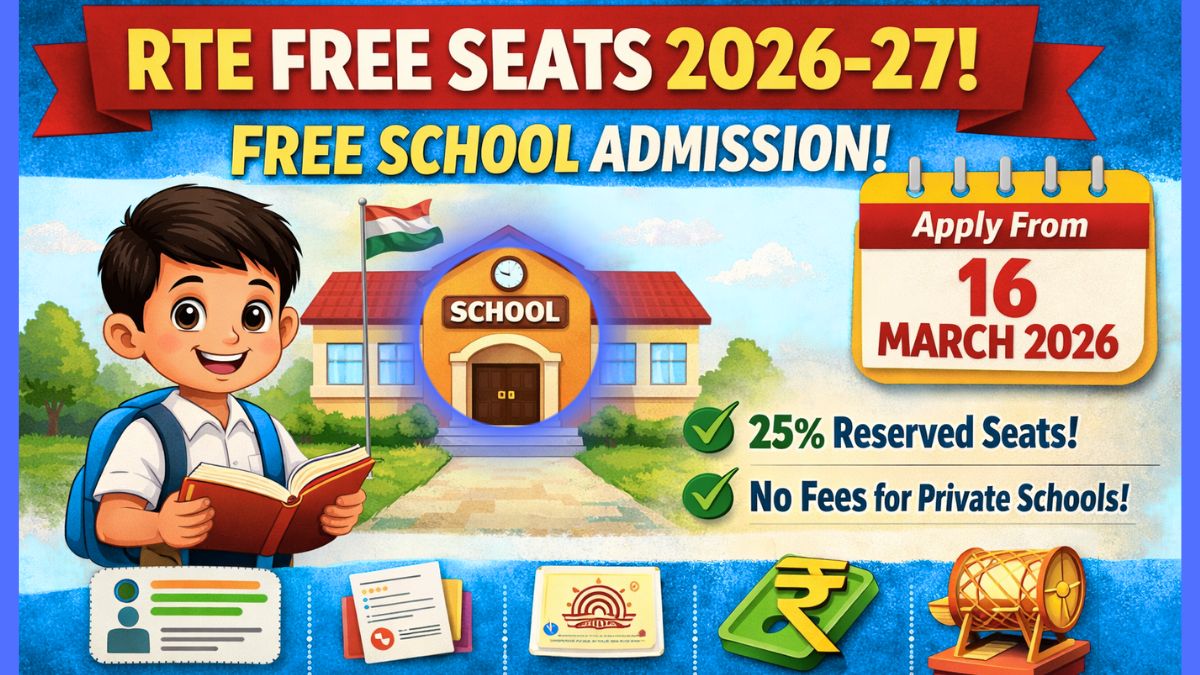
Free Seat :- It is the dream of every parent to make their children study in prestigious private schools of the state including Bangalore. However, when millions of rupees are asked for donation and fees, that dream goes down the drain. Don’t worry! The Education Department has relaunched the free admission process for the year 2026-27 under the ‘Right to Education Act’ (RTE) which is a boon to poor and middle class parents.
Yes, finally the Revised Schedule for RTE Free Seats Admission has been released. Here is what you need to know for your child’s future.
When does the application start? (The Big Date):
Parents be alert! Online application for RTE Free Admission for academic year 2026-27 will start from March 16, 2026. This is the percentage available to children joining LKG or Class 1 in private unaided schools. 25% are reserved seats.
Urgent work to be done now! (Urgent Action Required): Don’t just sit back because there is still time to apply. Get these documents ready now to avoid last minute hassles. Application cannot be submitted without:
- Income/Caste Certificate: This is very important. RD Number must be in your certificate. If the period has expired, go to ‘Nadakacheri’ or ‘Karnataka One’ today and apply for a new one. (Generally the annual income should be within ₹3.5 lakh).
- Aadhaar Cards: Have Aadhaar card of child, Aadhaar card of both father and mother ready. Note: Make sure that child’s name and date of birth are same in birth certificate and aadhaar card.
- Birth Certificate: This is required to confirm the child’s age.
- Address Proof: Ration Card, Voter ID or Aadhaar.
- Photo: Recent passport size photograph of child.
Important Dates at a Glance:
- Published School List: 10.03.2026
- Online Application Start (Application Start): 16.03.2026
- Last Date to Apply: 15.04.2026
- 1st Round Lottery Result: 27.04.2026
- How old should your child be? (Age Limit Rules):
- To be added to LKG: Child must be at least 3 years 10 months old.
- For admission to 1st class: Child should be at least 5 years and 10 months old.
An Expert Tip for Parents:
- As per the “neighborhood school” rule, you are allowed to choose only schools within your area of residence (ward/panchayat). Can’t apply for distant schools. So, correct your documents today and get ready to apply on the official website of the Education Department on 16th March!
Share this information with your friends, relatives, help the education of a poor student.
Click on the link to apply:- https://schooleducation.karnataka.gov.in/
Parents pay special attention to:
Please read the following points before you apply online:
- Data Matching: The name, date of birth and parents’ names in the child’s Aadhaar card must be the same as in the birth certificate. If there is any discrepancy, get the Aadhaar card amended before applying (by March 16).
- Don’t pay anyone: RTE application submission is completely free. Don’t believe if someone asks for money saying “we will give you a seat”. Seat allotment is done through a fully transparent ‘Online Lottery’.
- One application per child: Do not attempt to submit more than one application in the name of one child, as this may lead to rejection of the application.
- Official Website: For application and more information refer to official website of Education Department schooleducation.karnataka.gov.in only.
The relaunch of the RTE Free Seat Admission process for the 2026–27 academic year represents more than just an administrative update; it is a profound opportunity for social mobility across Karnataka. For many families, the rising cost of private education—often inflated by hidden fees and “donations”—has historically acted as a barrier to quality learning. By mandating a 25% reservation for the underprivileged, the RTE Act creates a more inclusive classroom environment where a child’s potential is not dictated by their family’s bank balance. This scheme is a cornerstone of educational equity, ensuring that the dream of attending a reputed private institution is accessible to every child, regardless of their financial background.
However, the success of this opportunity rests heavily on the proactive engagement of parents. The window for application is relatively brief, and the technical requirements for documentation are stringent. The shift toward a fully digital, Aadhaar-linked application process means that there is zero margin for error. Discrepancies between a child’s birth certificate and their Aadhaar card, or an expired Income Certificate, are the most common reasons for rejection. Therefore, the period leading up to March 16 is “golden time” for preparation. Parents must treat this phase with the same level of importance as the admission itself, visiting Nadakacheri or Karnataka One centers early to verify that every digit and spelling on their official paperwork is correct.
Furthermore, the “Neighborhood School Rule” highlights the importance of local community integration. By limiting admissions to schools within a specific ward or panchayat, the government ensures that young children do not face grueling commutes, while also encouraging schools to serve their immediate communities. This localized approach simplifies the logistics for working-class families and fosters a sense of belonging for the student within their own neighborhood. Parents should use the week prior to the application start date—specifically after the official school list is published on March 10—to research the eligible institutions in their vicinity to make an informed choice.
Ultimately, the RTE computerized lottery system is designed to provide a fair and transparent chance to all applicants. While the demand often exceeds the number of available seats, the system eliminates the influence of “recommendations” or “influence,” placing every eligible child on a level playing field. Even if a child is not selected in the first round, the existence of subsequent rounds provides a glimmer of hope for those on the waiting list. For the families who secure a seat, the impact is life-changing. It marks the beginning of an educational journey that can break the cycle of poverty, providing children with the tools, confidence, and environment needed to succeed in a competitive world. This 2026–27 cycle is a call to action for parents to empower their children’s futures through timely and diligent preparation.
The Founder of Fresh Rise and a global educator, a digital news platform focused on delivering clear, verified, and meaningful stories that matter to everyday readers. I write about current affairs, government schemes, education, social issues, and global developments, presenting complex topics in a simple and easy-to-understand format.
With a background in teaching and content creation, I believes that information should be accessible to everyone. Through Fresh Rise, i aim to help readers stay informed with factual reporting, practical insights, and timely updates.