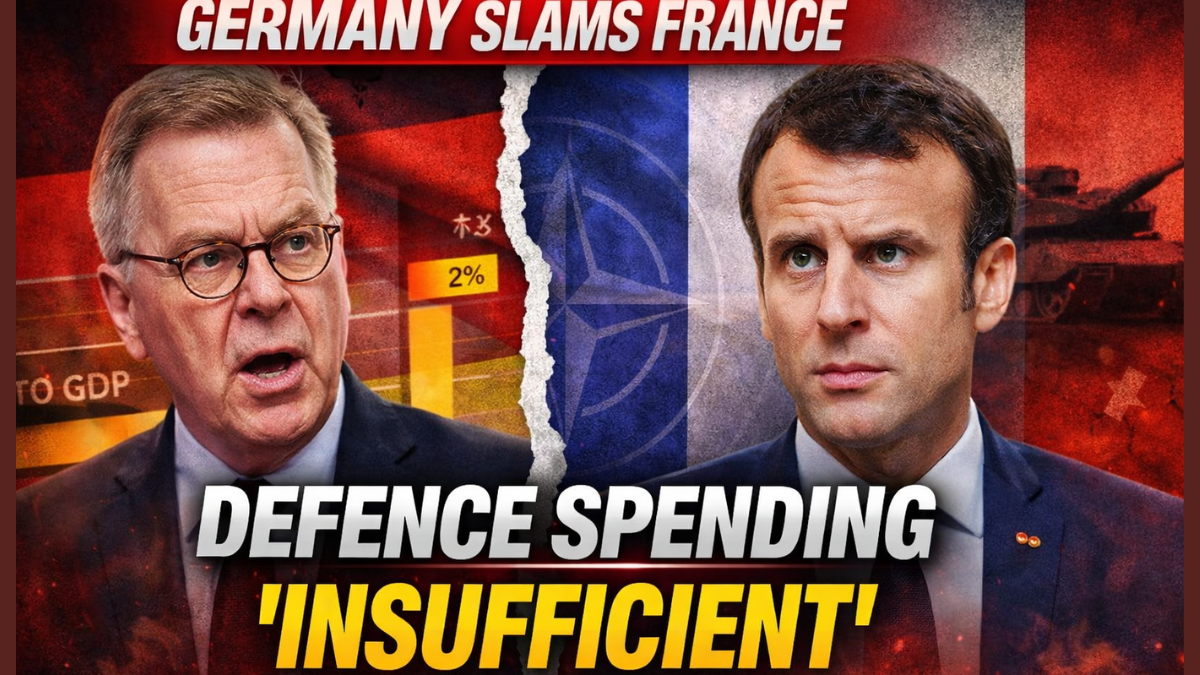
Germany’s foreign minister says French defence spending is insufficient, sending a sharp political signal across Europe. The rare public rebuke of France has triggered debate at a time when the continent is under pressure to strengthen its security.
The comments come as NATO allies commit to spending more on defence and security. But progress, according to Berlin, is too slow.
Is this a wake-up call for Paris? Or a deeper sign of shifting power inside Europe?
Germany’s foreign minister says French defence spending is insufficient – What Happened?
In a radio interview with German broadcaster Deutschlandfunk, Johann Wadephul directly questioned France’s pace on defence spending.
Referring to French president Emmanuel Macron, Wadephul said:
“Anyone who talks about European sovereignty needs to act accordingly in their own country.”
It was a strong message.
Last year, NATO members committed to spending 5% of GDP on defence and security by 2035. But Wadephul argued that efforts, including those in France, have been “insufficient.”
The focus keyword moment is clear: Germany’s foreign minister says French defence spending is insufficient, and he wants faster action.
Why This Defence Debate Matters for Europe
Since Russia’s full-scale invasion of Ukraine in February 2022, European security priorities have changed dramatically.
Germany, once criticised for underspending, has now unleashed hundreds of billions of euros into rearmament. Berlin even exempted most defence spending from constitutional debt limits.
Current German budgets foresee:
-
Over €50bn in defence spending between 2025 and 2029
-
Increased military readiness
-
Stronger NATO commitments
France, however, faces financial pressure due to a high debt burden. That limits how much room Paris has for rapid spending increases.
The tension reflects a larger European dilemma:
-
Can Europe afford stronger defence?
-
Can it afford not to?
NATO Targets and the Pressure to Act
All members of NATO now meet the minimum 2% GDP defence spending target. But new goals go further:
-
3.5% for core defence
-
1.5% for resilience and security infrastructure
-
Deadline: 2035
That means a combined 5% commitment.
The statement that Germany’s foreign minister says French defence spending is insufficient adds pressure on Paris to show measurable progress.
Security experts argue that Europe can no longer rely fully on the United States. The debate over European sovereignty — often championed by Macron — now faces real financial tests.
For detailed NATO spending data, readers can refer to NATO’s official defence expenditure reports.
Wider Political Context: Rubio, Orbán and Europe’s Shifting Alliances
The defence debate unfolds alongside high-level diplomacy across Europe.
US secretary of state Marco Rubio is currently in Budapest meeting Hungarian prime minister Viktor Orbán.
Orbán described US-Hungary relations as entering a “new golden age,” thanking US president Donald Trump for strong ties.
Meanwhile, Hungary faces elections on 12 April, with Orbán challenged by opposition leader Péter Magyar.
These events matter because:
-
Hungary has frequently blocked EU sanctions on Russia.
-
Europe remains divided on Ukraine support.
-
Defence spending debates influence political narratives before elections.
At the same time, EU foreign policy chief Kaja Kallas rejected what she called “fashionable euro-bashing” from Washington, defending Europe’s values and unity.
The remark that Germany’s foreign minister says French defence spending is insufficient adds another layer to this fragile diplomatic balance.
The Ukraine Factor and Navalny Fallout
Security concerns are not theoretical.
The Kremlin recently rejected claims from five European countries that Russian opposition leader Alexei Navalny was killed using a poison linked to dart frog toxins.
European governments plan to report Russia to the Organization for the Prohibition of Chemical Weapons.
Against this backdrop, defence readiness is no longer abstract policy. It feels urgent.
And that urgency explains why Germany’s foreign minister says French defence spending is insufficient — because Europe sees growing threats.
A Big Change in Germany’s Defence Identity
For decades, Germany was cautious about military expansion due to historical reasons. That has changed dramatically.
The war in Ukraine triggered a “Zeitenwende” — a turning point in German security policy.
Berlin is now:
-
Investing heavily in military modernisation
-
Expanding ammunition production
-
Strengthening NATO’s eastern flank
This transformation gives Germany moral confidence to demand similar action from partners.
But public criticism of France is unusual. Paris and Berlin traditionally lead Europe together.
Now, tension is visible.
A Strategic Wake-Up Call
The statement that Germany’s foreign minister says French defence spending is insufficient may seem like a political disagreement. But it signals something deeper — a redefinition of European power dynamics.
Germany is no longer the hesitant security actor. It is positioning itself as a leader demanding responsibility from others.
France, on the other hand, champions European sovereignty but faces budget realities. Macron has long called for strategic autonomy from the US. But autonomy requires funding.
This is not just about percentages.
It is about credibility.
If Europe wants to speak with one voice on Ukraine, NATO, and global security, unity must be backed by spending commitments. Without financial alignment, political statements lose weight.
At the same time, public disagreements risk weakening European unity when it is most needed.
Behind the numbers lies a larger emotional truth: Europe feels vulnerable.
From war in Ukraine to shifting US alliances and rising far-right politics, leaders are under pressure. Defence spending debates reflect fear, ambition and responsibility all at once.
When Germany’s foreign minister says French defence spending is insufficient, it is more than a headline. It is a warning bell.
Europe is at a crossroads.
Will it act boldly and collectively? Or will internal disagreements slow momentum?
Security is no longer optional. It is urgent. And every euro allocated — or delayed — carries strategic consequences.
As NATO targets approach and elections loom, the coming months could shape Europe’s future for decades.
Stay informed. Share this analysis with those following Europe’s defence debate. Because when Germany’s foreign minister says French defence spending is insufficient, the entire continent listens.
FAQ
Why did Germany’s foreign minister say French defence spending is insufficient?
Germany’s foreign minister says French defence spending is insufficient because he believes France has not progressed fast enough toward NATO’s 5% GDP defence and security target by 2035. The remarks reflect growing pressure within Europe to increase military readiness amid security threats and geopolitical tensions.
Read More:- https://freshrise.in/samajwadi-party-leader-killed-high-mast-pole-falls-car-up/
Link:- https://kapublic.com/cbse-board-exam-dress-code-rules-kannada/#more-661

The Founder of Fresh Rise and a global educator, a digital news platform focused on delivering clear, verified, and meaningful stories that matter to everyday readers. I write about current affairs, government schemes, education, social issues, and global developments, presenting complex topics in a simple and easy-to-understand format.
With a background in teaching and content creation, I believes that information should be accessible to everyone. Through Fresh Rise, i aim to help readers stay informed with factual reporting, practical insights, and timely updates.