How Trump’s isolationism pushed the world to China is no longer just a political talking point — it is now backed by numbers, charts, and voting data at the United Nations.
In 2026, something dramatic is happening on the world stage.
America looks more isolated. China looks stronger.
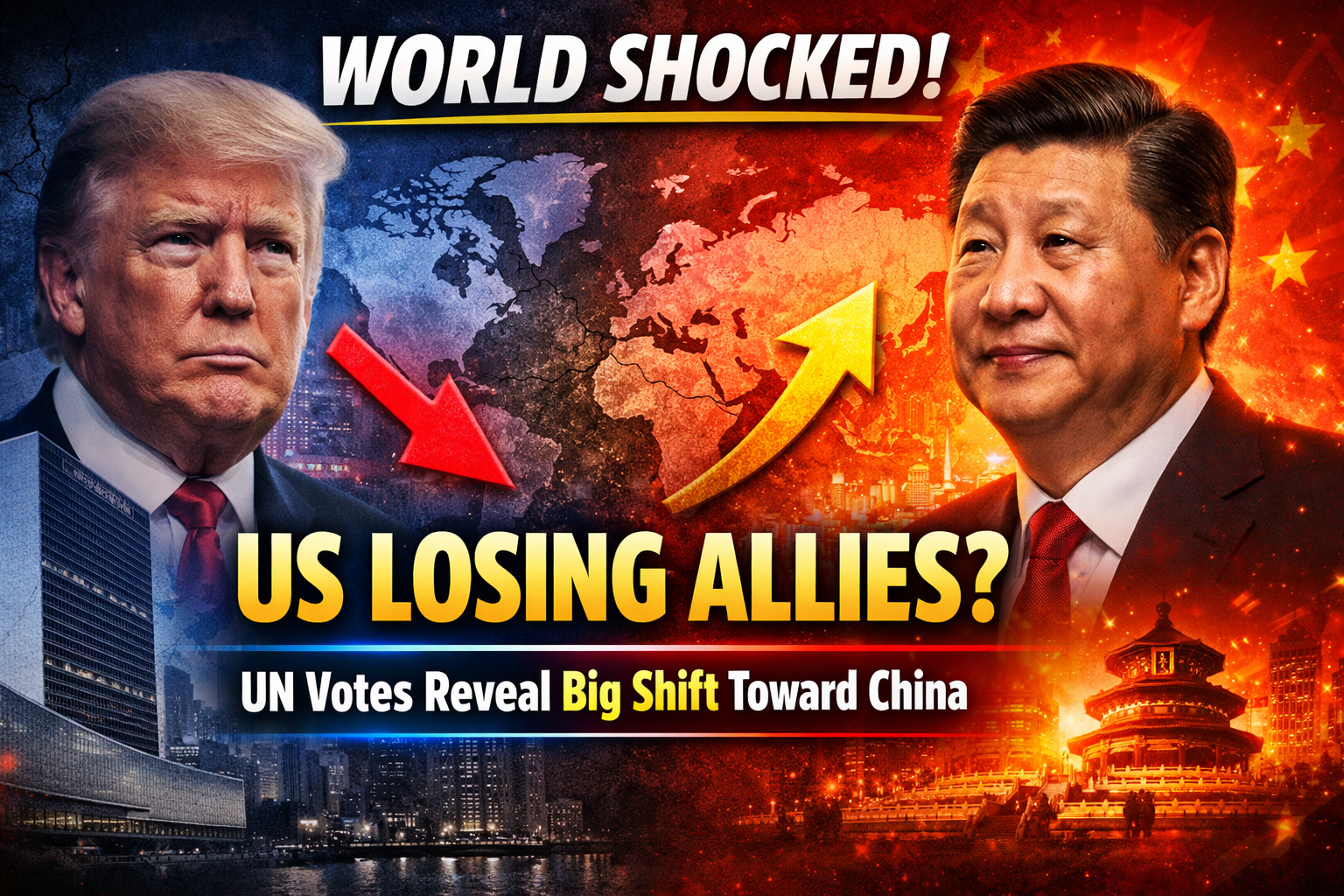
New analysis of UN General Assembly votes shows a shocking change in global alliances since Donald Trump returned to the White House. Countries that once stood shoulder-to-shoulder with Washington are now drifting away — and many are moving closer to China.
This is not a small shift. It could reshape the global order for decades.
How Trump’s Isolationism Pushed the World to China in Just One Year
According to research by Focal Data, UN voting patterns act as a powerful mirror of geopolitical alignment. When countries consistently vote together on contested resolutions, they usually share common interests.
The findings reveal:
-
The number of countries strongly aligned with the US has dropped from 46 to just seven.
-
China’s bloc of roughly 73 aligned countries has remained largely stable.
-
Western allies are voting with Washington far less frequently.
This is the clearest evidence yet of How Trump’s isolationism pushed the world to China.
Under Trump’s “America First” approach, the US has taken controversial stances on global issues — and many traditional allies have chosen a different path.
UN Voting Records Show a Dramatic Collapse in US Alignment
The UN General Assembly has become a key battlefield.
Researchers created a scoring system:
-
+1 = always voting with China
-
-1 = always voting with the US
In 2025, several longtime American allies moved sharply away from Washington. Among them:
-
Canada
-
Germany
-
Japan
-
South Korea
-
United Kingdom
The shift is historic.
For decades, NATO and Western democracies formed the backbone of American global influence. Today, that unity looks fragile.
Ukraine and Gaza: Flashpoints That Changed Everything
Two major votes accelerated the global shift.
Ukraine War Resolution
In February 2025, the US voted against a resolution condemning Russia for the war in Ukraine — aligning itself with:
-
Russia
-
Belarus
-
North Korea
Many European allies were stunned.
Gaza Civilian Protection Resolution
In June 2025, the US opposed a resolution calling for protection of civilians in Gaza. The majority of Western countries supported the resolution. China voted in favor.
Even more striking, the US vetoed a UN Security Council ceasefire resolution — disagreeing not only with China and Russia, but also with France and the UK.
These moments fueled the perception of isolation.
And they strongly illustrate How Trump’s isolationism pushed the world to China.
Europe Is Drifting — But Not Because It Loves Beijing
Interestingly, Europe’s shift is less about embracing China and more about distancing from Washington.
The UK’s alignment with the US has fallen to its lowest level in recorded history. This coincides with renewed diplomatic outreach between London and Beijing.
Meanwhile, Asia, Africa, and South America continue to show stronger structural alignment with China — especially developing nations.
The key takeaway:
-
Europe is voting less with the US.
-
Developing nations are clustering closer to China.
-
The global “center of gravity” is moving east.
Economic Power Is Tilting Toward Beijing
Here’s where the story becomes even bigger.
When researchers weighted alliances by GDP:
-
Under Obama and Biden, US-aligned countries held greater combined economic power.
-
Under Trump’s second term, China-aligned countries now collectively surpass US-aligned nations in economic strength.
Even more striking:
Fast-growing economies — especially in Asia and Africa — tend to cluster closer to Beijing in voting patterns.
That suggests the future may lean toward China.
This economic factor makes How Trump’s isolationism pushed the world to China more than just a diplomatic story. It is a long-term structural transformation.
The Beehive vs. The Jenga Tower
Data journalists compared the two systems of influence:
-
China’s network is like a beehive — broad, decentralized, resilient.
-
US influence is like a Jenga tower — heavily dependent on a core group of European allies.
If those allies move away, the structure weakens.
And that is exactly what appears to be happening.
Only two countries — Argentina and Israel — were firmly aligned with the Trump White House in 2025.
That is a dramatic contraction of influence.
What Happens Next?
Experts warn this trend may accelerate.
If current projections hold, the global center of geopolitical gravity could shift into China’s orbit by the late 2030s.
This is not about ideology alone. It is about:
-
Trade
-
Infrastructure investment
-
Development partnerships
-
Climate policy
-
Diplomatic consistency
Countries follow stability and opportunity.
Right now, many see predictability in Beijing — and volatility in Washington.
For more global political analysis, you may also read our deep dive on the evolving US-China rivalry (internal link suggestion).
For official UN voting data, visit the United Nations General Assembly website (external authority link suggestion).
The story of How Trump’s isolationism pushed the world to China is not just about charts. It is about trust.
Alliances are built over decades.
But they can weaken quickly.
For many European nations, the emotional shock came when Washington voted differently on Ukraine. For others, it was Gaza. For developing countries, it was climate and migration votes.
America once positioned itself as the center of a liberal democratic order. Now, it appears more unpredictable.
Meanwhile, China has carefully maintained a steady voting bloc of more than 70 nations. It has cultivated relationships across Africa, Latin America, and Asia.
If economic growth continues in these regions, Beijing’s influence could expand dramatically.
The global order is not collapsing overnight. But it is changing — quietly, steadily, and perhaps permanently.
This is the real story behind How Trump’s isolationism pushed the world to China.
History rarely announces itself loudly.
Sometimes, it shifts in quiet UN voting halls, in small diplomatic meetings, in resolutions most citizens never read.
But those votes matter.
They reveal loyalty.
They reveal frustration.
They reveal opportunity.
If the current pattern continues, the late 2020s may be remembered as the decade when the global balance tilted east.
Whether that shift is temporary or permanent depends on future leadership, diplomacy, and economic partnerships.
One thing is clear: the world is watching closely.
And the data does not lie.
If this global transformation concerns you, share this article and join the discussion. The future of international alliances may depend on conversations happening today.
FAQ
Q: What does “How Trump’s isolationism pushed the world to China” mean?
It refers to the growing evidence from UN voting records that many countries are aligning less with the US and more with China during Donald Trump’s second term, reflecting a broader geopolitical shift.
Read More:- https://freshrise.in/bangladesh-election-bnp-claims-win-after-hasina-overthrow/
Link:- https://kapublic.com/https-kapublic-com-p616previewtrue/#more-616

The Founder of Fresh Rise and a global educator, a digital news platform focused on delivering clear, verified, and meaningful stories that matter to everyday readers. I write about current affairs, government schemes, education, social issues, and global developments, presenting complex topics in a simple and easy-to-understand format.
With a background in teaching and content creation, I believes that information should be accessible to everyone. Through Fresh Rise, i aim to help readers stay informed with factual reporting, practical insights, and timely updates.