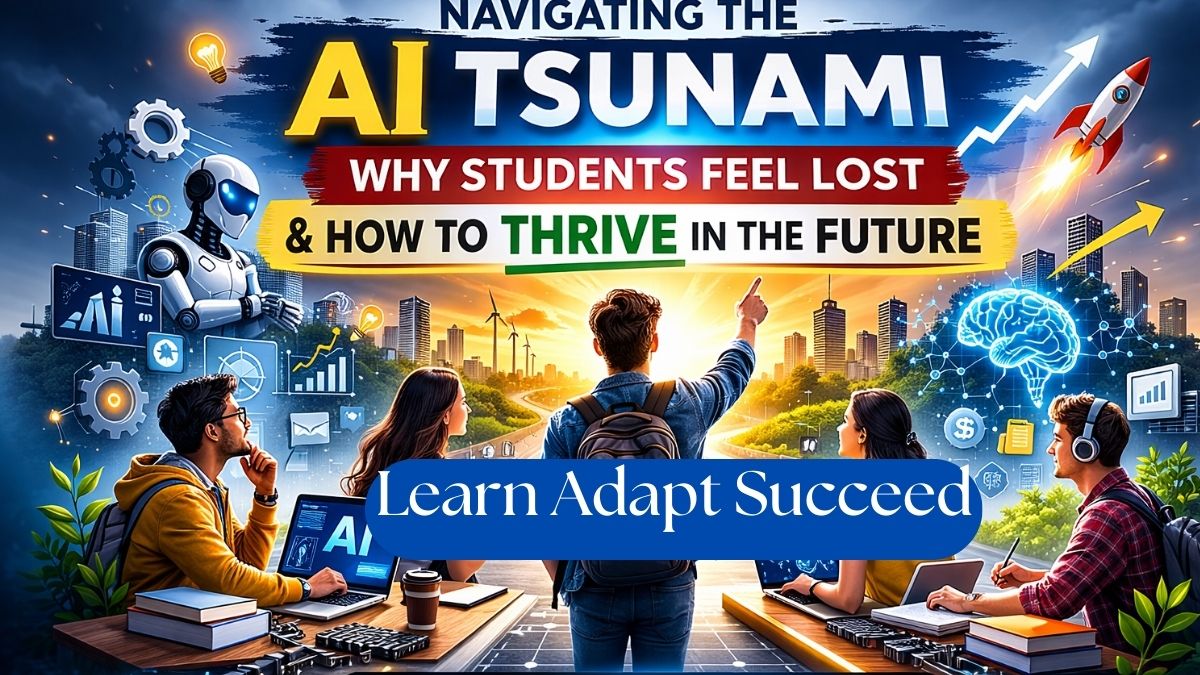
Navigating the AI Tsunami: AI Future for Students — Why They Feel Lost and How to Thrive-The world is changing faster than any generation has experienced before. Artificial Intelligence is no longer a futuristic concept discussed only by scientists or tech experts. It is already shaping how we learn, work, communicate, and make decisions every day.
For many college students, this rapid transformation feels overwhelming. Career paths that once seemed stable now appear uncertain. Skills that were valuable yesterday may seem outdated today. Social media constantly discusses automation, layoffs, and AI replacing humans, creating anxiety about the future.
It is natural to feel confused.
But here is the truth: the AI era is not the end of opportunities. It is the beginning of a new kind of opportunity — one that rewards adaptability, creativity, and continuous learning.
This guide explains why students feel lost in the AI revolution and provides clear, practical strategies to help them thrive instead of fear the future.
Why Students Feel Lost in the AI Era
Many students today experience uncertainty not because they lack ability, but because they are navigating a world undergoing massive transformation.
1. Fear of Job Displacement
One of the biggest fears is that AI will replace jobs. Automation already handles tasks like data entry, customer support responses, and even content generation. Students worry that years of education might become irrelevant.
However, history shows that technological revolutions do not eliminate work entirely — they transform it. New roles always emerge alongside new technologies.
2. Uncertainty About Future Skills
Students often ask:
-
Should I learn coding?
-
Is data science necessary?
-
Will creativity still matter?
-
What skills will exist in 10 years?
The rapid evolution of AI makes long-term planning difficult, leading many students into decision paralysis.
3. Information Overload
The internet is filled with conflicting opinions:
-
“AI will replace everyone.”
-
“AI will create unlimited jobs.”
-
“You must learn AI immediately.”
This overload creates confusion instead of clarity. Without proper guidance, students struggle to separate hype from reality.
4. AI as a “Black Box”
Most students use AI daily through chatbots, recommendation systems, and digital assistants but do not understand how it works. This lack of understanding creates fear and helplessness.
When technology feels mysterious, it feels threatening.
5. Education Systems Lag Behind Technology
Universities are trying to adapt, but curriculum updates take time. Many students feel their education is not aligned with real-world technological changes, increasing anxiety about employability.
6. Pressure to Specialize Too Early
Students feel pressured to choose AI-related careers immediately, even when they are still discovering their interests. This pressure often leads to stress and self-doubt.
Understanding AI’s Real Impact: Beyond the Fear
To thrive, students must first understand what AI actually is.
AI is not a replacement for humans. It is a tool that amplifies human capability.
AI as an Augmenter
AI performs repetitive, data-heavy tasks efficiently. Humans provide:
-
judgment
-
creativity
-
empathy
-
context understanding
-
ethical reasoning
The future workforce will combine human intelligence with machine efficiency.
New Roles Are Emerging
Many modern jobs did not exist ten years ago. Similarly, AI is creating new career paths such as:
-
AI trainers
-
Prompt engineers
-
AI ethicists
-
Human-AI interaction designers
-
Data storytellers
-
AI product managers
The opportunity landscape is expanding, not shrinking.
Democratization of Technology
Today, anyone can use AI tools without advanced programming knowledge. No-code platforms allow students from arts, commerce, or humanities backgrounds to leverage AI effectively.
How Students Can Thrive in the AI Era
1. Embrace Lifelong Learning
The most valuable skill today is learning how to learn.
Instead of mastering one skill permanently, successful individuals continuously update their knowledge.
Action Steps:
-
Take short online courses regularly.
-
Follow technology trends.
-
Learn new tools every few months.
-
Build curiosity as a habit.
Platforms like Coursera, edX, and LinkedIn Learning provide accessible learning opportunities.
2. Develop Uniquely Human Skills
AI excels at computation but struggles with human-centered abilities.
Future-proof skills include:
Critical Thinking
Understanding problems deeply and evaluating solutions thoughtfully.
Creativity
Generating original ideas and innovation beyond patterns.
Communication
Explaining complex ideas clearly and collaborating effectively.
Emotional Intelligence
Understanding people, building relationships, and leading teams.
Ethical Decision-Making
Ensuring technology benefits society responsibly.
These skills will become more valuable, not less.
3. Learn AI Fundamentals (Without Becoming a Programmer)
Students do not need advanced coding skills to benefit from AI.
Start by understanding:
-
Machine learning basics
-
Natural language processing
-
Data concepts
-
AI limitations and biases
Experiment with tools like ChatGPT or AI design platforms to gain practical exposure.
Understanding AI removes fear and builds confidence.
4. Use AI as a Personal Assistant
Students who succeed will treat AI as a partner.
AI can help with:
-
summarizing research
-
generating study notes
-
brainstorming ideas
-
improving writing
-
learning coding concepts
-
practicing interviews
Instead of competing with AI, learn to collaborate with it.
5. Build Networks and Collaborate
The future of work is collaborative.
Students should:
-
join online communities
-
discuss ideas with peers
-
find mentors in emerging fields
-
participate in interdisciplinary projects
Innovation increasingly happens at the intersection of multiple fields.
AI Future for Students: Opportunities and Benefits
Students who adapt early gain significant advantages.
Increased Employability
Nearly every profession will integrate AI tools. Understanding AI becomes a universal advantage.
Entrepreneurial Opportunities
AI reduces startup costs by enabling automation, content creation, and data analysis with minimal resources.
Students can launch businesses faster than ever before.
Higher Earning Potential
Emerging skill sets command premium salaries because demand exceeds supply.
Solving Global Challenges
AI is helping address major problems such as climate change, healthcare improvement, and education accessibility.
Students can contribute meaningfully to global progress.
Personalized Learning
AI enables customized learning paths based on individual strengths and weaknesses, accelerating skill development.
Opportunities for Career Switchers and New Income Streams
The AI era is especially powerful for individuals seeking change.
Strategic Reskilling
Identify transferable skills such as:
-
communication
-
analysis
-
teaching
-
creativity
-
leadership
Then combine them with AI knowledge.
Example:
A marketing graduate becomes an AI marketing strategist.
Gig Economy Opportunities
AI creates new freelance roles:
-
AI content creator
-
Prompt specialist
-
AI workflow consultant
-
AI tutor
-
Data annotation specialist
These roles allow flexible income generation.
Entrepreneurship Using AI
Students and professionals can build:
-
AI-powered niche products
-
automated digital services
-
personalized learning platforms
-
AI-driven marketing solutions
AI lowers the barrier to entrepreneurship dramatically.
Hybrid Careers
Future jobs will blend traditional expertise with AI tools:
-
Doctors using AI diagnostics
-
Teachers using AI learning analytics
-
Lawyers using AI research assistants
-
Designers using generative AI
Human expertise combined with AI efficiency defines future success.
Resources to Begin Your AI Journey
Learning Platforms
-
Coursera
-
edX
-
Udemy
-
LinkedIn Learning
-
DataCamp
AI Tools to Explore
-
ChatGPT
-
Microsoft Copilot
-
Google AI tools
-
Stable Diffusion
-
Midjourney
Communities
-
AI discussion forums
-
technology newsletters
-
student innovation groups
Conclusion: The Future Belongs to the Adaptable
Feeling lost in the AI era is not a weakness. It is a natural response to rapid change.
But uncertainty also signals opportunity.
Students who choose curiosity over fear, learning over hesitation, and adaptability over rigidity will not just survive this transformation — they will lead it.
AI is not replacing human potential. It is expanding it.
The future will belong to individuals who combine human creativity with technological intelligence, who learn continuously, and who see change as an invitation rather than a threat.
The AI revolution is not something happening to students.
It is something students have the power to shape.
And that journey begins today.
Read More:- https://aiskillshub.org.uk/

The Founder of Fresh Rise and a global educator, a digital news platform focused on delivering clear, verified, and meaningful stories that matter to everyday readers. I write about current affairs, government schemes, education, social issues, and global developments, presenting complex topics in a simple and easy-to-understand format.
With a background in teaching and content creation, I believes that information should be accessible to everyone. Through Fresh Rise, i aim to help readers stay informed with factual reporting, practical insights, and timely updates.