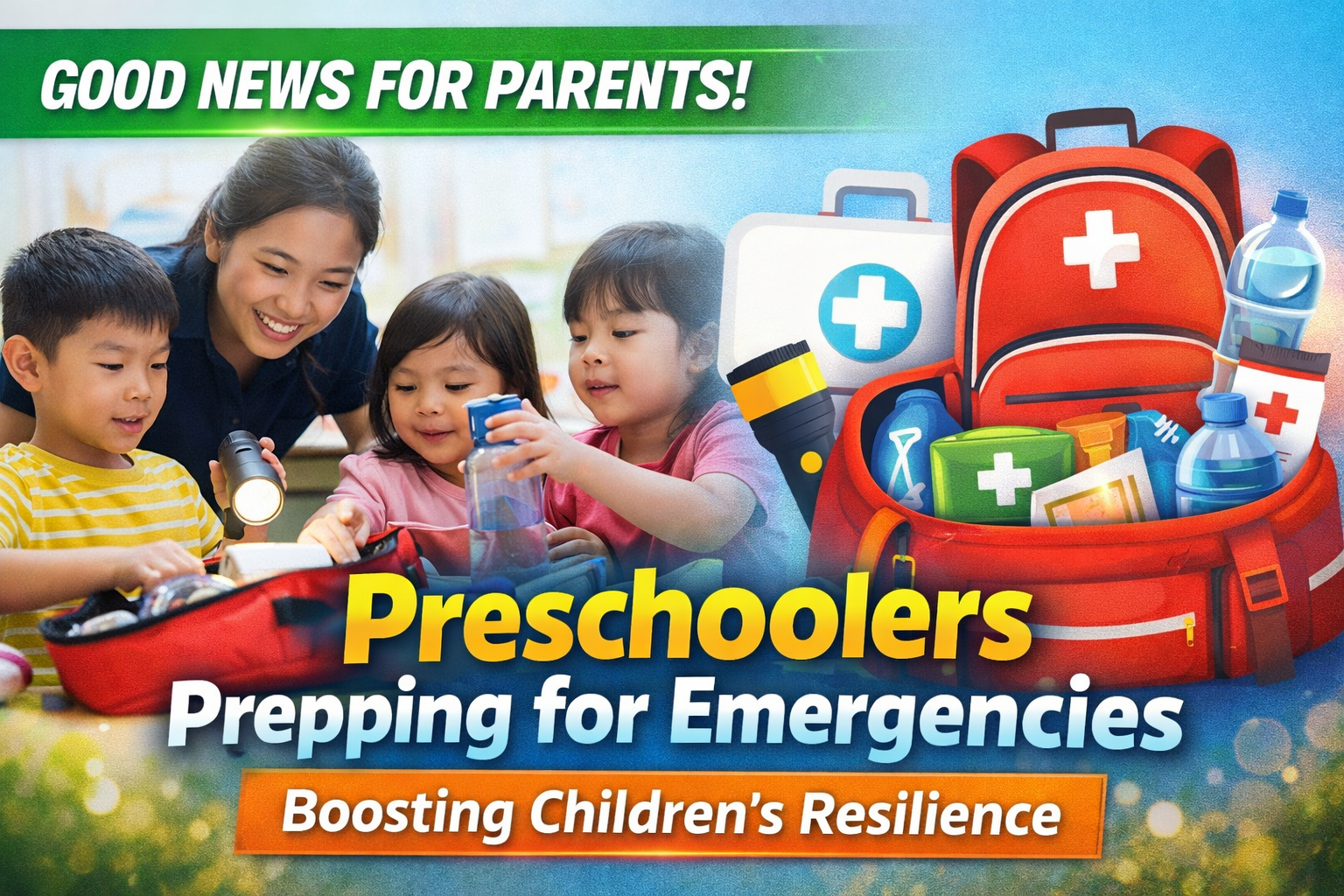
Preschoolers learn to prep emergency kits in pilot to boost psychological resilience, and the initiative is being seen as a powerful and heartwarming shift in early childhood education in Singapore.
Packing emergency supplies. Walking through dark rooms. Helping friends stay calm.
These are not typical preschool activities. Yet at Sunflower Preschool @ Hillview, children are doing exactly that — and experts are calling it a big change in how resilience is taught from a young age.
In a world filled with uncertainty, this feels like good news.
Preschoolers Learn to Prep Emergency Kits in Pilot to Boost Psychological Resilience
The pilot programme was introduced as part of this year’s Total Defence exercise in Singapore. It aims to build psychological resilience early — not during adulthood, but in the most formative years of life.
Through a three-part immersive workshop, children were guided through:
- Packing their own emergency kits
- Navigating unfamiliar environments in low light
- Working together during simulated uncertainty
Centre manager Mastura Adam shared that the results have been encouraging.
“We see the children displaying learning dispositions such as perseverance and resilience,” she said. “We also see them lending their friends a helping hand when they are faced with challenges.”
This is not just about emergencies. It is about emotional strength.
Building Resilience Early: Why Experts Say This Matters
Starting Young Is Key
Experts agree that resilience is not something that magically appears in adulthood. It is built slowly, through experiences — both small and big.
Early childhood practitioner Samantha Tan, a member of the Advisory Council on Community Relations in Defence (ACCORD), emphasised that resilience can and should start early.
“It’s not that we only foster it in adulthood,” she said. “It can happen to anyone, anytime, at any age.”
When preschoolers learn to prep emergency kits in pilot to boost psychological resilience, they are not being frightened. They are being empowered.
That difference matters.
Breaking the Misconception
There is a common belief that children are too young to understand difficult situations.
Dr Annabelle Chow, principal clinical psychologist at Annabelle Psychology, challenges that idea.
She explained that resilience can be nurtured from as young as four — as long as the methods are age-appropriate.
Simple tools include:
- Teaching children to label their feelings
- Helping them understand that distress is temporary
- Encouraging problem-solving during small challenges
“It helps them build the capacity to manage bigger matters later,” she said.
This is not shock-based training. It is confidence-building.
How the Programme Works
The immersive workshop focuses on practical, emotional, and social learning.
When preschoolers learn to prep emergency kits in pilot to boost psychological resilience, they are guided step by step.
What Children Practise
- Identifying essential emergency items
- Staying calm in darker environments
- Working as a team
- Asking for help when unsure
These activities teach children that uncertainty does not mean danger. It means adaptation.
And adaptation is a life skill.
Beyond Preschool: A Nationwide Resilience Alert
Singapore has been steadily strengthening psychological resilience under its Total Defence framework. This preschool pilot is part of a broader national effort.
At the Singapore Red Cross (SRC), psychological first aid courses are equipping individuals to support people dealing with shock, grief, or emotional distress.
The goal is clear:
- Prevent panic
- Support recovery
- Reduce long-term trauma
Youth currently make up about 20 per cent of participants in these courses. SRC hopes to increase that number by another 5 percentage points.
This shows a bigger trend — resilience is becoming a national priority.
For more updates on education reforms in Singapore, you may also read our coverage on early childhood innovation programmes (internal link suggestion).
For official information about Singapore’s Total Defence movement, visit the Ministry of Defence website (external authority link suggestion).
Why Psychological Resilience Is a Life Skill
When preschoolers learn to prep emergency kits in pilot to boost psychological resilience, they are learning something much bigger than preparedness.
They are learning that:
- Fear can be managed
- Emotions can be named
- Challenges can be solved
- Help is available
Dr Chow explained that even simple emotional awareness makes a difference.
Teaching children that “this distress will come and go” builds mental flexibility. Over time, that flexibility becomes strength.
And strength becomes confidence.
Closing Reflection: A Big Change in How We Prepare the Next Generation
This initiative represents more than a classroom activity. It signals a quiet but powerful shift in how society views children and their capabilities.
For decades, difficult conversations were often shielded from young minds. The assumption was that innocence equals safety. But the world has changed. Crises — whether global pandemics, natural disasters, or personal losses — do not wait for adulthood.
By allowing preschoolers to gently explore preparedness in a safe environment, educators are giving them something incredibly valuable: emotional tools before the storm arrives.
The beauty of this programme is not in the emergency kits themselves. It is in the small moments — a child encouraging a friend in the dark, another calmly explaining what goes into a kit, a teacher guiding them through uncertainty without panic.
These are seeds of resilience.
And seeds planted early grow strong roots.
When preschoolers learn to prep emergency kits in pilot to boost psychological resilience, they are building foundations for calmer communities in the future. A resilient child becomes a resilient adult. A resilient adult strengthens families. Strong families strengthen nations.
This is not just a school activity. It is nation-building at its most basic level.
A Community Effort That Brings Good News
There is something deeply reassuring about watching a society invest in emotional strength rather than reacting only after crises hit.
This initiative is good news in a time when headlines are often filled with stress and uncertainty.
It shows that resilience is not about toughness. It is about adaptability, empathy, and calm thinking under pressure.
Parents, educators, and policymakers are working together to nurture these traits early. That collaboration is powerful.
And perhaps most importantly, it reminds us that children are not fragile observers of the world. They are capable learners. They can understand feelings. They can practise calm. They can support one another.
Preschoolers learn to prep emergency kits in pilot to boost psychological resilience — and in doing so, they may be teaching adults something too: preparation begins with awareness, and awareness begins with courage.
If this story inspired you, share it with fellow parents and educators. Let’s spread the message that resilience can start small — and grow big.
FAQ
Why are preschoolers learn to prep emergency kits in pilot to boost psychological resilience important?
Preschoolers learn to prep emergency kits in pilot to boost psychological resilience because early exposure to age-appropriate challenges helps children build emotional awareness, problem-solving skills, and calm responses to uncertainty. Experts say resilience developed early becomes a lifelong strength.
Read More:- https://freshrise.in/mehli-mistry-seeks-scrapping-of-vc-position-at-tata-trusts/
Link:- https://kapublic.com/https-kapublic-com-p601previewtrue/#more-601

The Founder of Fresh Rise and a global educator, a digital news platform focused on delivering clear, verified, and meaningful stories that matter to everyday readers. I write about current affairs, government schemes, education, social issues, and global developments, presenting complex topics in a simple and easy-to-understand format.
With a background in teaching and content creation, I believes that information should be accessible to everyone. Through Fresh Rise, i aim to help readers stay informed with factual reporting, practical insights, and timely updates.