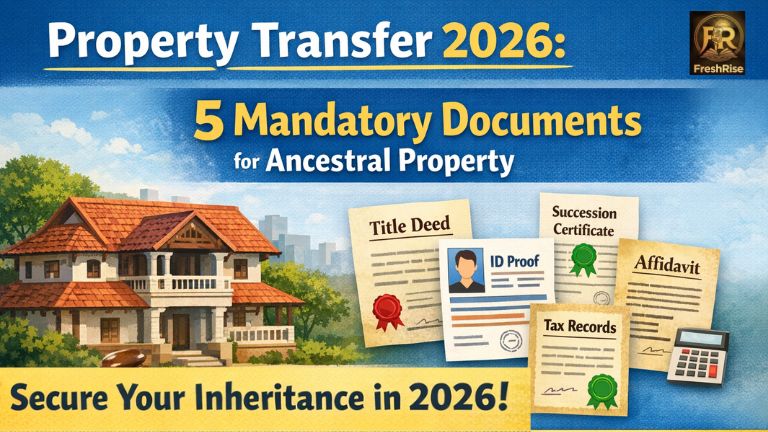
Property Transfer 2026: 5 Mandatory Documents to Transfer Ancestral Property to Your Name
In India, property is more than just land or brick and mortar; it is a legacy passed down through generations. Whether it is a farmhouse from your grandfather or a house built by your parents, inheriting ancestral property is a moment of pride. However, many families make the mistake of relying only on verbal agreements or “family understandings.”
In 2026, with rising real estate values and stricter digital record-keeping by the government, a verbal nod is no longer enough. To truly call that land yours, you must complete the legal Property Transfer process. Without the right paperwork, the Revenue Department will not recognize you as the owner, which could lead to heart-breaking legal battles later.
If you are planning to secure your inheritance this year, here are the five essential documents you need to make the transfer legally foolproof.
1. Original Title Deeds (The Chain of Ownership)
The Title Deed is the foundation of any property claim. It proves who the original owner was and how the property moved from one person to another over decades.
In your “Title Chain,” you might need:
-
Sale Deed: If the ancestor originally bought the land.
-
Partition Deed: If the property was divided among siblings previously.
-
Gift Deed: If it was handed over as a gift.
Why is this vital? Without a clear title chain, revenue officers cannot verify the history of the land, making it nearly impossible to sell or mortgage the property in the future.
2. Death Certificate and Legal Heir Certificate
When the original owner (father, mother, or grandparent) passes away, the law needs proof of two things: that the owner is deceased and who is legally next in line.
-
Death Certificate: Issued by the municipal or village office, confirming the passing of the original owner.
-
Legal Heir Certificate: Obtained from the Tehsildar’s office, this document lists all surviving family members who have a legal right to the property.
Pro Tip: Ensure every eligible heir’s name is correctly spelled as per their Aadhaar card to avoid delays in the Revenue Department.
3. RTC (Pahani) for Agricultural Land
If the ancestral property is farmland, the RTC (Record of Rights, Tenancy and Crops) is your most important document. It provides a snapshot of:
-
Total area of the land.
-
Type of soil and crops grown.
-
Current owner’s name in government records.
In 2026, most states have digitized RTCs. Ensure the survey numbers match your physical boundaries exactly before proceeding with the transfer.
4. Encumbrance Certificate (EC)
An Encumbrance Certificate proves that the property is “free and clear.” It shows whether there are any existing:
-
Unpaid bank loans or mortgages.
-
Legal injunctions or court stays.
-
Prior sales that you might not be aware of.
Experts recommend pulling an EC for the last 15 to 30 years to ensure no hidden liabilities haunt your inheritance.
5. Mutation and Khata Transfer
This is the final and most crucial step. Mutation (or Khata Transfer in urban areas) is the process of updating the government’s revenue records to reflect your name as the owner.
Once Mutation is complete:
-
You become the official taxpayer for the property.
-
The property appears in your name in government portals.
-
You gain the legal right to sell, gift, or use the land as collateral for loans.
Key Benefits of Having These Documents Ready
-
Legal Immunity: Protects you from third-party claims or fraudulent sales.
-
Peace of Mind: Resolves potential disputes within the extended family.
-
Financial Freedom: Allows you to apply for home improvement or business loans easily.
-
Higher Value: Clear documentation significantly increases the market price of the property.
Practical Advice for 2026 Property Owners
The government is rapidly moving toward “One Nation, One Registration” systems. If your ancestral records are still on old paper, visit your local Sub-Registrar or Tehsildar office immediately to digitize them. Keeping your records updated online is the best way to prevent land encroachment.
Conclusion
Transferring ancestral property is not just about paperwork; it’s about securing your family’s future. By organizing these five documents—Title Deeds, Death/Heir Certificates, RTC, EC, and Mutation—you ensure that your legacy remains safe and undisputed. Don’t wait for a dispute to arise; start your Property Transfer process today.
FAQs (Frequently Asked Questions)
1. How do I start the property transfer process? Gather the Title Deed and Death Certificate, then apply for a Legal Heir Certificate at the Tehsildar office to initiate the name change.
2. What happens if the original Title Deed is lost? You can apply for a certified “Certified Copy” from the Sub-Registrar’s office where the property was originally registered.
3. Is an Encumbrance Certificate (EC) mandatory for inheritance? While not always mandatory for the name change, it is essential to ensure you aren’t inheriting a property burdened by debt.
4. Can I sell ancestral property without a Khata Transfer? No. Most buyers and banks require the Khata (Mutation) to be in the seller’s name to verify current ownership.
5. Do I need a lawyer for this? For simple successions, you can do it yourself. However, if there are multiple heirs or missing documents, a property lawyer is highly recommended to avoid errors.
Read more:- https://freshrise.in/google-fellowship-2026-student-stipend-guide/
link:- https://vidyamana.net/google-fellowship-2026/

The Founder of Fresh Rise and a global educator, a digital news platform focused on delivering clear, verified, and meaningful stories that matter to everyday readers. I write about current affairs, government schemes, education, social issues, and global developments, presenting complex topics in a simple and easy-to-understand format.
With a background in teaching and content creation, I believes that information should be accessible to everyone. Through Fresh Rise, i aim to help readers stay informed with factual reporting, practical insights, and timely updates.