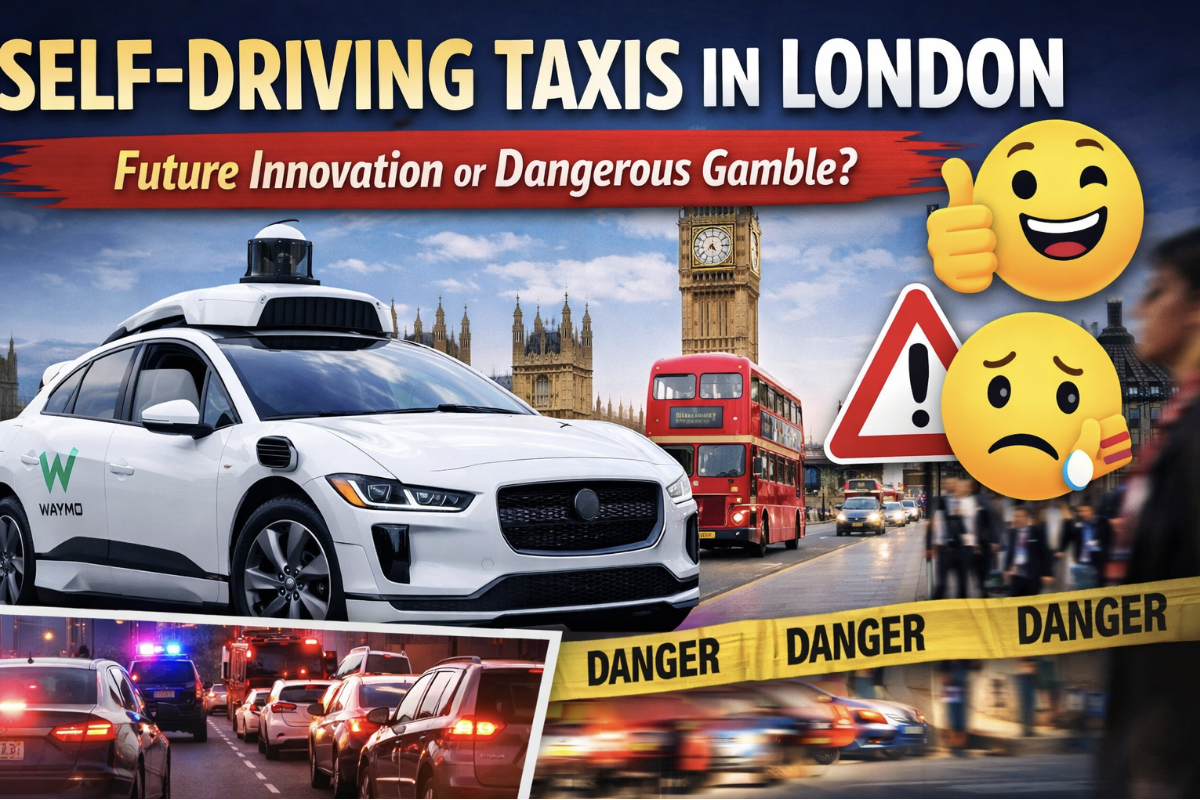
The Robotaxi Revolution Comes to London
Self-driving taxis — the futuristic idea once confined to sci-fi — are now becoming a real part of everyday life. American tech giant Waymo, backed by Google’s parent company Alphabet, has announced plans to bring fully autonomous taxis — popularly known as robotaxis — to London as early as 2026. While this is being hailed as a groundbreaking step toward smarter mobility, it also sparks concerns over public safety, the future of traditional transport, and how well self-driving technologies will adapt to a city unlike any other in the world.
🤖 What’s Happening Now? The Latest Developments
Several major news outlets report that:
🔹 Waymo plans to begin pilot testing in London this spring, with full commercial rides hoped to launch by September 2026, pending regulatory approval.
🔹 The UK government is preparing to change vehicle regulations to allow fully driverless operations on London roads.
🔹 Officials believe autonomous taxis could create jobs, attract investment, and contribute tens of billions to the UK economy by 2035.
🔹 Local tests are already underway to help AI systems learn London’s complicated streets — including narrow lanes, pedestrian crossings, and historic traffic patterns.
These new developments show that autonomous technology is no longer hypothetical — it’s nearly here.
🧠 Why London Is a Unique Challenge for Self-Driving Cars
When self-driving taxis first appeared in U.S. cities like San Francisco, Phoenix, and Los Angeles, they operated on wide, grid-style streets with predictable traffic behavior. That made it relatively easier for AI to learn patterns and avoid mistakes.
But London is different, and that’s a key concern:
🛣️ 1. Ancient Streets vs. Modern Machines
Many London roads were laid out long before cars existed, winding through old neighborhoods with tight corners, mixed traffic, cyclists, and pedestrians at every turn. These conditions make it more difficult for autonomous systems to predict movements and react rapidly.
🚶 2. Jaywalking Isn’t Illegal
Unlike many U.S. cities where “jaywalking” is discouraged or penalized, Londoners frequently cross streets informally. This kind of unregulated pedestrian behavior adds complexity to how robots interpret their surroundings.
🚍 3. Shared/Unpredictable Spaces
London is experimenting with shared space streets, where vehicles, bikes, and pedestrians mingle freely. While this slows vehicles and encourages caution, it creates ambiguous movement patterns that are hard for AI to decode.
🧩 Potential Benefits of Self-Driving Taxis
Despite the concerns, there are real advantages that technology promoters are betting on:
✅ 1. Safety Improvements
Waymo says that autonomous driving systems can reduce human error — such as distractions, drunk driving, or fatigue — and potentially decrease collisions compared to traditional cars.
✅ 2. Better Accessibility
Autonomous taxis could help people who cannot drive independently, such as the elderly or visually impaired, to travel more freely.
✅ 3. Transportation for All Times
Robotaxis may operate 24/7 without needing breaks, which could improve night-time travel options and reduce waits for shared rides.
✅ 4. Economic Growth
Officials estimate autonomous vehicles could add up to £42 billion and nearly 40,000 jobs to the UK economy by 2035.
❗ But There Are Big Concerns Too
❓ 1. Safety and Errors
Even in the U.S., autonomous taxis have had minor but disruptive incidents — from obstructing emergency vehicles to causing gridlocks and even hitting pets.
How tolerant will Londoners be of such mistakes?
❓ 2. Transparency and Trust
Most of the safety data comes directly from the companies themselves, and independent verification is limited. Researchers say companies must share more information to build public trust.
❓ 3. Job Impact
Traditional taxi drivers and private-hire workers — especially the iconic black cab drivers of London — fear for their livelihoods as autonomous fleets grow.
❓ 4. Urban Transport Strategy
London has successfully reduced personal car use and increased walking, cycling, and public transport. If self-driving taxis pull people away from buses and bikes, there’s a risk this progress could be reversed.
🧑⚖️ Regulation and Public Involvement
The UK government has taken a more hands-on role than in some other countries:
🚦 Cities will have a say in how autonomous vehicles are regulated, unlike in many parts of the U.S.
⚖️ Regulators are working to ensure that autonomous vehicles reach a safety level equal to or better than human drivers before they are widely deployed.
This kind of public involvement and oversight could make London’s launch more responsible — if done correctly.
🧭 Final Thoughts — Caution or Excitement?
When Waymo’s robotaxis first roll through London streets later this year, the experience will likely feel magical at first — a vision of the future where you tap an app and a car arrives with no driver.
But beneath the excitement lies a critical period of evaluation. London must navigate a balance between innovation and responsibility:
🔹 Will autonomous taxis make London safer or riskier?
🔹 Will they complement public transportation or undermine it?
🔹 Will they be affordable or only benefit a few?
🔹 Will regulators genuinely oversee the technology or let hype lead the way?
These are the questions that will shape the future of transport in one of the world’s most iconic cities.

The Founder of Fresh Rise and a global educator, a digital news platform focused on delivering clear, verified, and meaningful stories that matter to everyday readers. I write about current affairs, government schemes, education, social issues, and global developments, presenting complex topics in a simple and easy-to-understand format.
With a background in teaching and content creation, I believes that information should be accessible to everyone. Through Fresh Rise, i aim to help readers stay informed with factual reporting, practical insights, and timely updates.