In a sudden and surprising turn in global trade relations, the United States and India announced on February 2, 2026 that they have reached an agreement to end a year-long trade dispute that had escalated tariffs and strained diplomatic and economic ties. The announcement, made almost simultaneously by President Donald Trump and India’s Prime Minister Narendra Modi on social media, promises a reset in bilateral economic relations — but leaves the world waiting for clarity on what exactly the deal entails.
For months, what began as a tariff disagreement evolved into a wider economic standoff involving issues ranging from oil imports to geopolitical relations. That fraught chapter now seems to be closing — at least symbolically — with an agreement to reduce tariffs and revive cooperation between the two largest democracies on Earth.
US The Headlines: What Leaders Announced
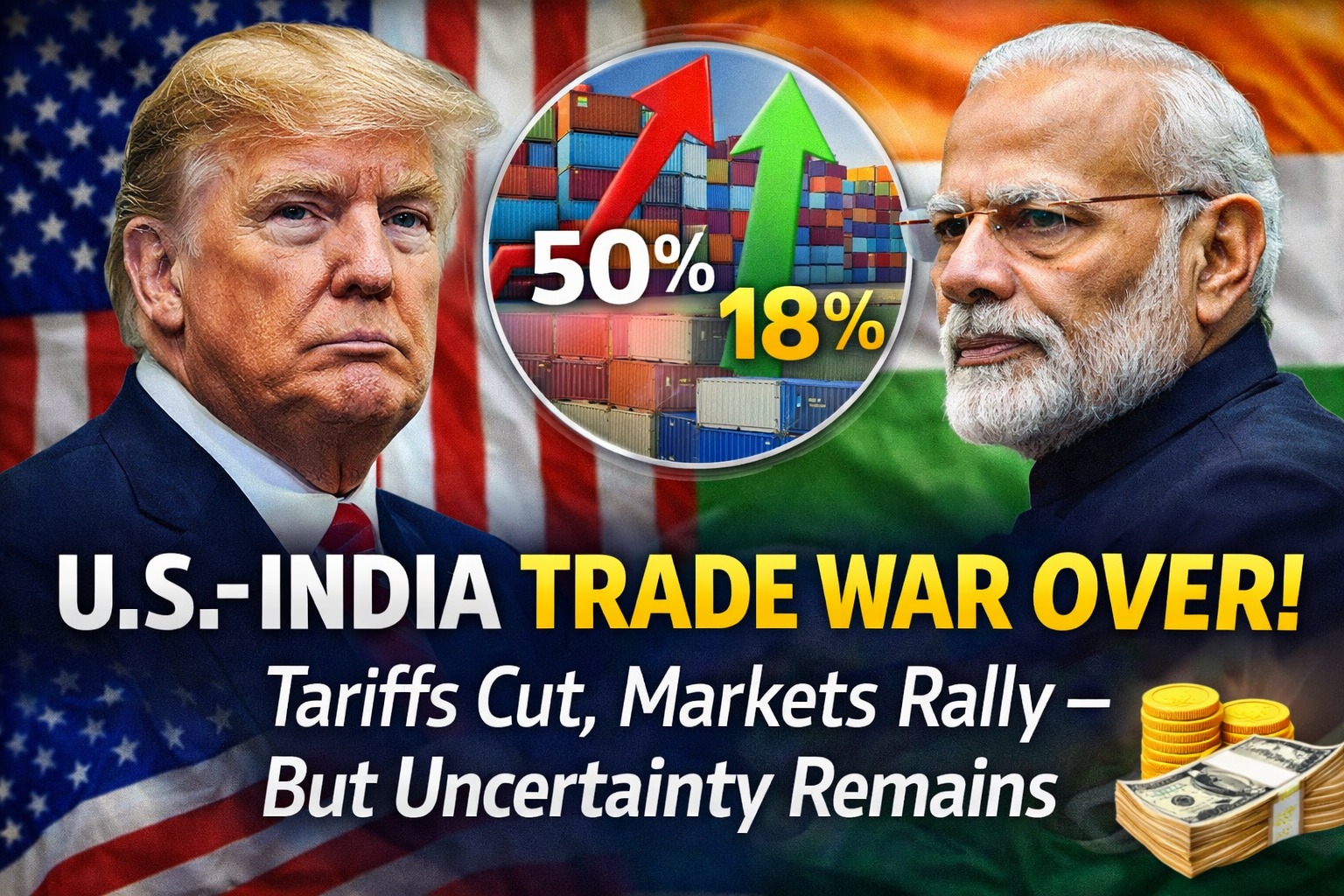
In a post on his platform, President Trump declared that the United States and India had reached a trade deal that would see U.S. tariffs on Indian goods reduced to 18% from around 50%. The higher figure reflected both a 25% reciprocal tariff and an additional punitive duty tied to India’s previous purchases of Russian crude.
Prime Minister Modi followed up with his own statement, expressing appreciation for the dialogue and highlighting the potential benefits for both nations. He spoke of “immense opportunities” stemming from the agreement while thanking President Trump personally.
📉 Why Tariffs Had Risen So Sharply
The dispute traces back to August 2025, when the Trump administration imposed sweeping tariff increases on Indian goods — essentially doubling duties to some of the highest rates imposed on any trading partner. Those duties were linked to concerns around India’s strategic purchases of discounted Russian oil and broader trade imbalances.
The punitive tariff, combined with a reciprocal tariff structure, placed a heavy burden on Indian exporters who rely heavily on the U.S. as a top destination market for products ranging from textiles to engineering goods. Much of the uncertainty revolved around how long high duties would persist and whether they would be lifted or expanded. That cloud overshadowed trade planning and investment, particularly in sectors deeply tied to American market access.
📊 What’s in the New Deal So Far?
🔹 U.S. Cuts Tariffs to 18%
Under the newly announced deal, the U.S. will reduce the country-specific tariff on Indian goods to 18%. This reduction is significant and was welcomed by markets — notably in India, where the Nifty 50 index rallied nearly 3% and the rupee strengthened in response to the news.
🔹 India’s Promises Remain Less Clear
President Trump’s statement also suggested that India would reduce its own tariffs and non-tariff barriers on U.S. goods, potentially to zero duty, and would commit to buying more American products — possibly to the tune of $500 billion. However, these lofty figures have so far been announced by Trump alone, and Indian officials have not released detailed confirmations or legal text on these commitments.
🔹 Russian Oil Controversy
One of the most contested points in the dispute was India’s purchases of Russian crude, which the United States cited as justification for punitive tariffs. President Trump’s announcement included a claim that India has agreed to halt purchases of Russian oil and instead buy more from the U.S. and potentially other countries, such as Venezuela. Indian officials have not publicly confirmed this shift, and New Delhi has traditionally maintained that its energy policy is calibrated to national interests and diversification.
📈 Market and Economic Reactions
The news brought immediate relief to financial markets:
- Indian equities soared, with benchmark indices recording one of their strongest single-day gains in years.
- Export sectors that were previously disadvantaged by high tariffs saw prospects of increased competitiveness.
- The Indian rupee appreciated sharply, strengthening investor confidence.
Economists and business leaders welcomed the move, saying that removing the tariff “overhang” could boost exports and strengthen economic cooperation, even as they caution that the finer details will determine the actual impact.
🧩 What Remains Unclear
While the headlines highlight tariff cuts and diplomatic warmth, several important questions remain unresolved:
1. Legal Text of the Agreement
No formal trade pact has yet been published by either the U.S. or Indian governments. Most of the details come from presidential and prime ministerial statements, which are not legally binding documents. Experts say the lack of a signed, publicly accessible agreement makes it difficult to assess enforcement mechanisms and timelines.
2. Details on India’s Commitments
The claim that India will purchase $500 billion worth of American goods over a set period lacks official confirmation. Analysts note that India’s total imports from the U.S. were far below that level in past years, suggesting that the figure may represent a long-term target or broad optimistic projection rather than a concrete one.
3. Sectoral Scope
Even with lower tariffs, certain categories — such as agricultural products, dairy, and politically sensitive items — may remain protected due to domestic policy considerations in India. This means not all U.S. products may gain duty-free or low-duty access immediately.
4. Energy Policy Direction
The energy component of the agreement — particularly the expectations around India halting Russian oil purchases — remains subject to interpretation. India has indeed reduced its Russian oil imports since earlier sanction pressures, but it has not fully committed to a complete stop, and energy sourcing continues to reflect its strategic imperatives.
🌍 Broader Strategic Context
The tariff agreement does not exist in isolation — it unfolds against a backdrop of shifting global trade dynamics:
- India recently concluded a comprehensive trade pact with the European Union, which provides alternative export opportunities and may have increased urgency for a U.S. deal.
- The Biden administration’s successor era paleois moving toward realignments in global supply chains, with many nations seeking diversified trade partnerships.
For the U.S., the deal represents a diplomatic achievement that could help strengthen ties with India while addressing geopolitical concerns about global energy flows and balance in supply chains.
🧠 Expert Perspectives
Trade economists believe that while the tariff cut removes a major point of contention, the ultimate benefits will depend on implementation and the broader architecture of trade relations between the two countries.
Some key viewpoints include:
- Exporters may see better market access but will still need to navigate tariff schedules and regulatory barriers.
- Negotiators may now shift toward a more comprehensive trade framework, which could encompass services, data flows, and intellectual property.
- Investors will watch carefully how commitments on purchases and energy sourcing unfold.
📌 What This Means Going Forward
The announcement signals a reset in US-India economic ties, with immediate relief for markets and exporters. But translating political statements into concrete trade flows, economic benefits, and legal commitments will be a complex and potentially lengthy process.
For businesses — both in India and the U.S. — the deal opens opportunities for renewed cooperation, investment, and expansion into each other’s markets. However, the speed at which detailed regulations and tariff schedules are finalized will determine the real economic impact.

The Founder of Fresh Rise and a global educator, a digital news platform focused on delivering clear, verified, and meaningful stories that matter to everyday readers. I write about current affairs, government schemes, education, social issues, and global developments, presenting complex topics in a simple and easy-to-understand format.
With a background in teaching and content creation, I believes that information should be accessible to everyone. Through Fresh Rise, i aim to help readers stay informed with factual reporting, practical insights, and timely updates.