US-Israel-Iran War, Day 6 Live: Khamenei’s Account Breaks Silence, Tehran Hit Again, and the World Watches Oil Prices Spiral
The war that nobody thought would last this long just got deadlier.
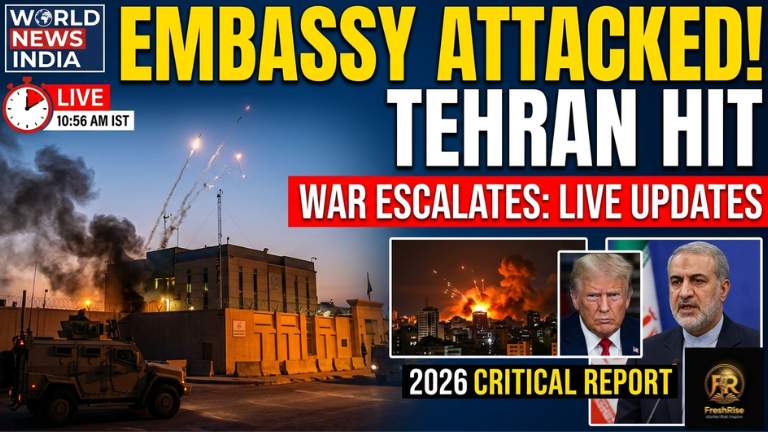
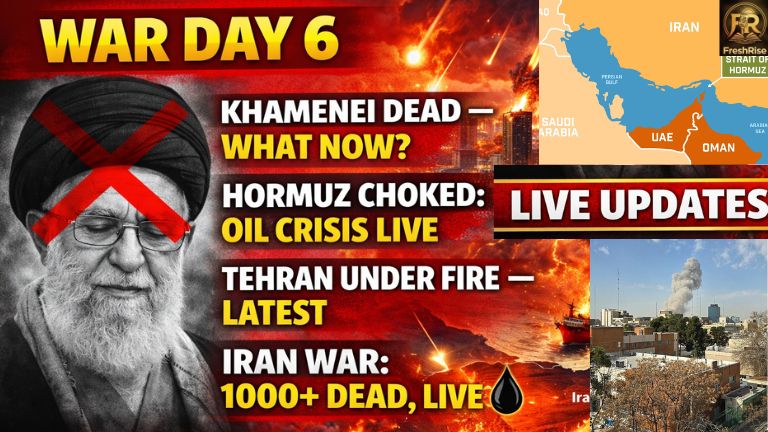
On Day 6 of the US-Israel-Iran war, the conflict has moved beyond anyone’s early predictions — spreading from Tehran’s skies to the Indian Ocean, from Gulf air bases to an Azerbaijani airport terminal. Over 1,000 people have now been killed in Iran alone. Nearly 200 children have lost their lives across the region since the weekend. And just hours after Ayatollah Ali Khamenei was confirmed dead, a post appeared on his official X account — warning the world that “the Zionist regime has made a big mistake.”
This article brings you the full picture of everything that happened on March 6, 2025: the key military strikes, the political chaos in Tehran, the naval warfare in the Indian Ocean, the collapsing energy markets and what it all means for India and the world.
| 1,000+ Killed in Iran |
70+ Killed in Lebanon |
181 Children Dead |
|
| 6 US Troops Killed |
100,000+ Fled Tehran |
−90% Hormuz Traffic |
What Happened on Day 6?
Six days into the most intense Middle East war since 2006, here is where things stand.
The United States and Israel have struck deep inside Iran, hitting the Revolutionary Guard, military academies, missile sites and symbols of state power in Tehran and Qom. Iran has retaliated with missile strikes toward Israel, drone attacks on Gulf US bases and warships in international waters.
Iran’s Supreme Leader Ayatollah Ali Khamenei has been killed — the most seismic development of the war. His mourning ceremony has been postponed due to ongoing strikes. Iran’s political structure is scrambling to find a successor, and more than 100,000 people have fled Tehran since fighting began.
On the global stage, the Strait of Hormuz — through which nearly 20% of the world’s oil passes — has seen tanker traffic collapse by 90 per cent. Oil prices have surged past $118 per barrel. Stock markets are falling. Shipping giants have suspended Gulf routes.
Khamenei’s X Account Posts After His Death — What We Know
The most unsettling development of the day came at 20:53 IST. A post appeared on the official X account of Ayatollah Ali Khamenei — confirmed dead at the start of the war — declaring: “The Zionist regime has made a big mistake.”
It is unclear who sent the message. Possibilities range from loyalists within Iran’s security apparatus using the account as a propaganda tool, to hardliners attempting to signal that the fight will continue regardless of leadership. The post drew immediate global attention and raised questions about who now controls Iran’s digital infrastructure — and its nuclear decision-making.
Naval War: US Submarine Sinks Iranian Warship in Indian Ocean
In what US Defense Secretary Pete Hegseth confirmed as a deliberate strike, an American submarine torpedoed and sank the Iranian vessel IRIS Dena in the Indian Ocean, off the southern coast of Sri Lanka.
At least 84 Iranian sailors were killed. Another 64 remain missing. Sri Lanka rescued 32 injured survivors and has sheltered over 250 Iranian sailors at a military camp near Colombo. A second Iranian ship, IRIS Bushehr, limped into Sri Lankan waters shortly after and remains under the country’s jurisdiction.
Sri Lanka condemned the human cost of the conflict while carefully maintaining its neutral position. The strike marked the most dramatic sea battle since the war began and dramatically extended the geographic scope of the conflict.
Iran Targets US Bases in UAE and Kuwait
Iran’s Islamic Revolutionary Guard Corps (IRGC) confirmed it struck US military forces at two Gulf bases — Al Dhafra Air Base in the UAE and Ali Al Salem Air Base in Kuwait. The strikes were framed by Tehran as part of its widening retaliation against American assets in the region.
These attacks on Gulf neighbours signal that Iran is willing to risk a much broader regional confrontation, potentially pulling the UAE and Kuwait more directly into the conflict. No immediate casualty figures were confirmed by the host nations.
Key Highlights: What Every ONE Needs to Know
- – Oil prices are climbing past $118/barrel — petrol price hikes in India are a near-certainty if the crisis continues
- Hormuz Strait traffic is down 90% — India gets nearly 60% of its oil imports from the Gulf
- Defence Minister Rajnath Singh warned: “What worries me is that this abnormality is becoming the new normal”
- The Indian government has activated consular emergency lines for citizens in Iran, Lebanon and the UAE
Civilian Cost: 3,643 Sites Damaged, 181 Children Killed in Iran
The Iranian Red Crescent released figures showing that 3,643 civilian sites have been damaged since the war began. This includes 3,090 homes, 528 commercial buildings, 14 medical facilities and nine Red Crescent buildings.
UNICEF confirmed at least 181 children killed in Iran, 7 in Lebanon, 3 in Israel and 1 in Kuwait since the escalation began on the weekend. The agency called for urgent protection of civilians and access for humanitarian workers.
The UN says tens of thousands have fled Tehran, with the capital under sustained bombardment and essential services severely strained.
The Conflict Spreads: Jordan, Saudi Arabia, Azerbaijan All Targeted
The war is no longer contained to Iran, Israel and Lebanon.
Saudi Arabia intercepted three drones east of Riyadh. Jordan shot down multiple drones over Irbid. Azerbaijan accused Iran of a drone strike on its Nakhchivan airport — four civilians were hurt and Baku has threatened retaliation. Iraq and the Kurdistan region issued statements saying their territory will not be used as a launchpad for attacks after Iran threatened to strike Kurdish dissident camps near the border.
This regional spillover is precisely what international analysts feared — and it is now happening in real time.
Washington Blocks War Powers Limits — Congress Backs Trump
The US House of Representatives narrowly defeated a resolution to limit Trump’s war powers in Iran — the second such vote in two days, following an earlier Senate defeat. The votes signal that despite some unease in Congress, the political backing for Trump’s military operation remains solid.
Trump himself told NBC News he considers a ground invasion of Iran a “waste of time” for now — but has not ruled out future options. He declared Iran had “lost their navy, lost everything they can lose” and rated the US military’s performance at “about a 15 — on a scale of 10.”
Energy and Markets: The Economic Earthquake Nobody Is Ready For
The Strait of Hormuz crisis is no longer theoretical. With tanker traffic down by nearly 90%, energy markets have entered a state of genuine fear.
Brent crude crossed $118 per barrel. Gold surged to $2,890 per ounce. The Sensex fell 1.4% in Thursday’s session. The rupee weakened against the dollar. US Energy Secretary Chris Wright said the Navy would escort ships through Hormuz “as soon as it’s reasonable” — but offered no firm timeline.
Shipping giants have suspended Gulf routes. LNG tankers are rerouting via the Cape of Good Hope, adding weeks and costs to deliveries. India’s fuel import bill is climbing with every passing day.
Expert Analysis: What Comes Next?
Strategic analysts watching the conflict point to three critical uncertainties that will define the next 72 hours.
The first is Iran’s succession crisis. Without a confirmed Supreme Leader, Iran’s military and political chain of command is at risk of fragmentation. Hard-liners may pursue more aggressive retaliation without centralised oversight. This is the most dangerous variable.
The second is the Gulf escalation. Now that Iran has struck bases in UAE and Kuwait, both countries face domestic pressure to respond or formally align with the US. Any further strike on their territory could force a formal diplomatic rupture.
The third is oil. If the Strait of Hormuz remains blocked for more than two weeks, analysts warn of a price shock that would rival the 1973 oil crisis. Governments across Asia — including India — are quietly releasing strategic reserves.
Conclusion
The US-Israel-Iran war has entered territory no one planned for. What started as targeted strikes on Iran’s military has become a multi-front conflict pulling in countries across the Gulf, South Asia and the Caucasus. Khamenei is dead, Tehran is burning and the world’s most important oil lane is grinding to a halt.
India’s stakes in this conflict are enormous — in energy, in the safety of its diaspora and in the broader question of regional stability that underpins its own growth story. Keep following this live blog for updates as the situation continues to evolve.
FAQs
Q1. Is there a full-scale war between the US and Iran in 2025?
Yes. As of March 6, 2025, the US and Israel are conducting active military strikes against Iran. Iran has retaliated with missiles, drones and naval actions. It is the most serious military confrontation between the US and Iran since the 2020 killing of General Qasem Soleimani — and far larger in scale.
Q2. Is Ayatollah Khamenei really dead?
Yes, Ayatollah Ali Khamenei has been reported dead in the early days of the conflict. His mourning ceremony has been postponed due to ongoing strikes. Iran has not publicly announced a successor as of March 6, and the country’s political leadership is in a state of uncertainty.
Q3. How does the Iran war affect India?
India imports nearly 60% of its oil from the Gulf region. The near-shutdown of the Strait of Hormuz has already pushed oil prices above $118 per barrel, with direct consequences for fuel prices, inflation and economic growth. Defence Minister Rajnath Singh has flagged this as a critical concern.
Q4. Are Indian citizens in Iran or the Middle East safe?
The Indian government has issued travel advisories for Iran, Lebanon and parts of the UAE. Indian embassies in affected countries have activated emergency helplines. Citizens are advised to register with the embassy, avoid public gatherings and follow official government guidance.
Q5. What is the Strait of Hormuz and why does it matter?
The Strait of Hormuz is a narrow waterway between Iran and Oman through which roughly 20–21 million barrels of oil pass every day — nearly 20% of global oil supply. Missile attacks in and around the strait have caused tanker traffic to fall by 90%, creating a potential energy crisis that is already driving up oil and gas prices worldwide.
READ MORE:-https://freshrise.in/thalapathy-vijay-trisha-spotted-wedding-divorce-news/

The Founder of Fresh Rise and a global educator, a digital news platform focused on delivering clear, verified, and meaningful stories that matter to everyday readers. I write about current affairs, government schemes, education, social issues, and global developments, presenting complex topics in a simple and easy-to-understand format.
With a background in teaching and content creation, I believes that information should be accessible to everyone. Through Fresh Rise, i aim to help readers stay informed with factual reporting, practical insights, and timely updates.