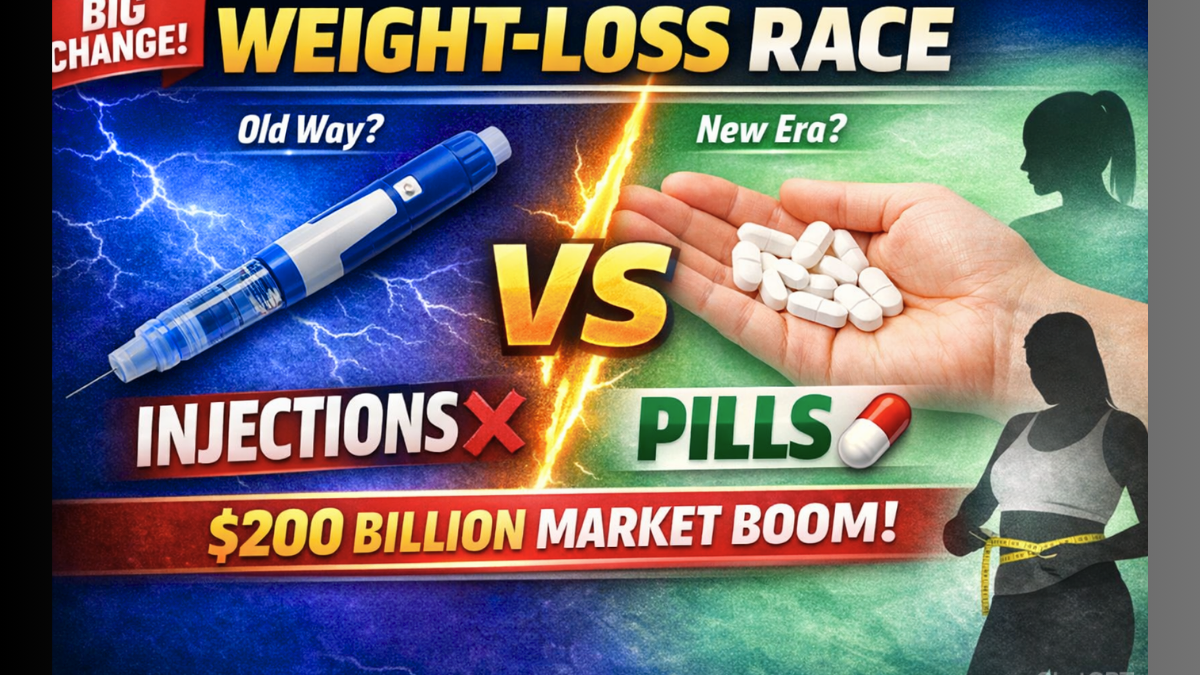
Weight-loss race is no longer just about injections. It is now about pills — and that change is sending shockwaves across the global pharmaceutical industry.
For millions struggling with obesity, this is big news. What once required weekly injections can now come in a simple daily tablet. And experts believe this shift could turn weight-loss treatments into one of the biggest healthcare revolutions of the decade.
The global anti-obesity market is predicted to hit $200 billion by the early 2030s. The Weight-loss race is accelerating — and it is becoming more personal, more accessible, and more mainstream than ever before.
The Weight-loss race moves from jabs to tablets
For years, injectable drugs like Wegovy by Novo Nordisk and Zepbound by Eli Lilly** dominated headlines.
These medications mimic the GLP-1 hormone, helping regulate appetite and blood sugar. Patients reported dramatic weight loss, improved health markers, and renewed confidence.
But injections come with challenges:
-
Needle anxiety
-
Refrigeration requirements
-
High monthly costs
-
Insurance limitations
Now, the arrival of the Wegovy pill — the first oral GLP-1 drug for weight loss approved in the US — marks a pivotal moment in the Weight-loss race.
Within weeks of launch, prescriptions surged to nearly 50,000 per week. Analysts even called it the fastest drug launch in history.
For many patients, swallowing a pill feels less intimidating than injecting a needle.
Why the Weight-loss race is expanding fast
The Weight-loss race is not only about convenience. It’s about access.
Pills are:
-
Cheaper than injections
-
Easier to distribute
-
Simpler to manufacture
-
More appealing to needle-averse patients
According to analysts at JPMorgan Chase, the GLP-1 market could grow from $75 billion today to $200 billion by the early 2030s.
And demand is not slowing down.
A recent poll by KFF found that one in eight adults in the US has tried a weight-loss drug. Many say affordability remains a challenge — but interest continues to rise.
In the UK, regulators are reviewing the pill version of Wegovy, with potential approval later this year.
Personal stories behind the headlines
Behind every prescription is a human story.
Melody Ewert, 44, switched from weekly injections to the Wegovy pill after her insurance changed. Her monthly cost for Zepbound jumped from $25 to $449.
The pill became the more affordable option.
She says the biggest change is consistency. Unlike injections — where appetite sometimes returned before the next dose — the daily pill keeps hunger steady.
Patrick, 33, from New Jersey, also made the switch. After regaining weight when insurance stopped covering injections, he decided to pay out of pocket for the tablet.
“It’s very simple, just to take a pill,” he says.
This simplicity could be the biggest driver in the Weight-loss race.
Big Pharma’s battle intensifies in the Weight-loss race
Competition is fierce.
Novo Nordisk may have launched first, but Eli Lilly is preparing to release its own oral pill, orforglipron. Unlike Wegovy, it is a small molecule drug — meaning no fasting requirement before taking it.
That difference could matter.
Meanwhile, companies like AstraZeneca are investing heavily in next-generation obesity treatments.
According to analysts at Goldman Sachs, 2026 could be a “pivotal year” in the obesity drug market. Pills may significantly expand the number of eligible patients.
Even Medicare will begin covering GLP-1 drugs for obesity — a move expected to push adoption even higher.
The Weight-loss race is no longer niche. It is global.
Effectiveness, side-effects, and real concerns
But it is not all good news.
Studies show:
-
Pills are slightly less effective than injections
-
About 1 in 10 users stop due to nausea or vomiting
-
Weight regain is common after stopping treatment
Research published in The Lancet predicts that more than half of adults worldwide may be overweight or obese by 2050.
That makes effective solutions urgent.
Still, cost-effectiveness remains debated. Researchers at the University of Chicago found injections fall short of government cost benchmarks — though pills may improve affordability over time.
The Weight-loss race is balancing hope with hard economics.
The global impact we haven’t fully seen
Here’s the reality: we are just at the beginning.
Obesity rates are rising, especially in lower-income countries. Healthcare systems are under pressure. And patients are demanding solutions that are easy, affordable, and effective.
Pills could unlock access for millions who were hesitant about injections.
They remove refrigeration barriers.
They reduce stigma.
They feel more “normal.”
And that psychological shift matters.
If you’re interested in understanding how GLP-1 works in the body, you may also want to read our detailed guide on how appetite hormones influence weight loss (internal link suggestion).
For official safety updates, readers can check the FDA website (external authority link suggestion).
What the future of the Weight-loss race could look like
The next few years could redefine obesity treatment.
Imagine:
-
Combination pills targeting multiple hormones
-
Treatments that preserve muscle mass
-
Lower prices due to competition
-
Wider insurance coverage
Analysts forecast peak annual sales of billions for these pills — though injections may remain the gold standard for severe obesity.
The Weight-loss race is not about replacing injections entirely. It is about expanding options.
Some patients will prefer weekly jabs.
Others will choose daily tablets.
Choice is power.
And in healthcare, that can change lives.
A turning point for millions
For people who have struggled for years — trying diets, exercise plans, and temporary fixes — this shift feels like real progress.
The emotional relief of fitting into airplane seats without extenders.
Shopping in regular stores.
Playing freely with children.
These are not small victories.
The Weight-loss race represents more than corporate competition. It represents a big change in how society treats obesity — less shame, more science.
Yet, the conversation must remain balanced. Access, safety, affordability, and long-term outcomes still matter deeply. Policymakers, insurers, and pharmaceutical companies will shape whether these treatments become a luxury or a mainstream solution.
As prices gradually fall and options increase, hope is growing.
Why this moment matters
The Weight-loss race is one of the most powerful healthcare stories of this decade.
It combines innovation, competition, emotion, and economics. Pills are making treatment more approachable — and that alone could shift millions of lives.
But the true impact will depend on fairness. Will lower-income families gain access? Will insurance expand coverage? Will long-term safety data support sustained use?
These are the questions that will define the next chapter.
If this article helped you understand the changing landscape of weight-loss treatments, share it with someone who might benefit. The Weight-loss race is not just about pharma — it is about people searching for healthier futures.
FAQ
What is the Weight-loss race in the pharmaceutical industry?
The Weight-loss race refers to the growing competition among major drugmakers to develop and sell effective obesity treatments, especially GLP-1 injections and now daily pills, as the market rapidly expands toward a projected $200 billion valuation.

The Founder of Fresh Rise and a global educator, a digital news platform focused on delivering clear, verified, and meaningful stories that matter to everyday readers. I write about current affairs, government schemes, education, social issues, and global developments, presenting complex topics in a simple and easy-to-understand format.
With a background in teaching and content creation, I believes that information should be accessible to everyone. Through Fresh Rise, i aim to help readers stay informed with factual reporting, practical insights, and timely updates.